

[2026] CTFL-AcT Exam Dumps, Test Engine Practice Test Questions
Pass CTFL-AcT exam [Jun 01, 2026] Updated 80 Questions
ISQI CTFL-AcT certification exam covers a broad range of topics related to acceptance testing, including the principles and concepts of acceptance testing, the role of acceptance testing in software development, the various types of acceptance testing, and the different techniques and tools used in acceptance testing. CTFL-AcT exam also covers the importance of collaboration and communication in acceptance testing, as well as the key skills and attributes required for successful acceptance testing.
NEW QUESTION # 34
Which one of the following statements describes the relation between business goals, business needs and requirements BEST?
- A. Business needs address the business solution whereas business requirements define the business problem or opportunity.
- B. To derive the business needs, the business analyst first has to understand the business goals and requirements.
- C. Business goals and business needs are synonyms.
- D. Business goals, business needs and requirements describe at different levels of abstraction, what shall be achieved.
Answer: D
NEW QUESTION # 35
As an acceptance tester you are analyzing the following user story for a computer web-based mass multiplayer role-playing game:
As an unregistered player
I want to be able to register myself by defining my e-mail, login and password in a registration form so that I become a registered player Consider the following propositions of the acceptance criteria:
i.a registration form is displayed on the screen.
ii.the form is written in the Groovy language; the cursor is initially set on the 'login' field; after pushing the TAB button the cursor switches to 'password', 'repeat password', 'mail', and 'repeat mail' forms.
iii.I cannot register myself if the login I choose is used by another player.
iv.after successful registration process I am informed about it by an e-mail.
Which of the above statements would you consider as well-written acceptance criteria?
- A. only ii) and iv)
- B. only i) and iii)
- C. only i), iii) and iv)
- D. only ii)
Answer: C
NEW QUESTION # 36
Which of the following sentences explains BEST how business process and business rule modeling can be used for ATDD?
- A. In an ATDD approach, testers use business process and business rule models to generate acceptance tests.
- B. In an ATDD approach, business process/rule models must be created before the project starts.
- C. In an ATDD approach, process models are created for initial test design but are not maintained afterwards.
- D. In an ATDD approach, business process models replace acceptance criteria.
Answer: A
Explanation:
Acceptance Test-Driven Development (ATDD) is a collaborative approach in which acceptance criteria are defined early, often before implementation starts. Business process models (e.g., BPMN) and business rule models (e.g., DMN) are essential tools to formalize how the system should behave under various conditions.
In ATDD, these models provide a structured representation of system workflows and decision logic, which can then be used by testers and stakeholders to derive or generate acceptance tests. This ensures that testing is aligned with actual business processes and requirements.
Option C is correct because it aligns with the purpose of ATDD: to use business models as a foundation for deriving acceptance tests in collaboration with business analysts, testers, and developers.
Other options:
A is incorrect - models are created as part of the project, not necessarily before it starts.
B is incorrect - models support and clarify acceptance criteria; they do not replace them.
D is incorrect - models are maintained as living documentation, especially in agile and iterative approaches.
C). In an ATDD approach, testers use business process and business rule models to generate acceptance tests.
NEW QUESTION # 37
Which of the following statements corresponds BEST to a UX requirement analysis activity?
- A. Security requirements are derived from usage scenarios.
- B. User profiles are used to determine different levels of business knowledge.
- C. Personas are used to analyze products or solutions from competitors.
- D. Environmental conditions such as light conditions are obtained from a task analysis.
Answer: B
NEW QUESTION # 38
Assume you would like to create a model describing a loan request process in a bank.
The loan request process starts when the customer submits a loan application. The bank then reviews the application. Regardless of whether the loan request is approved or not, a letter is sent to inform the customer of the decision. If the request is approved, the loan contract is created.
You have drawn the following business process model using BPMN 2.0.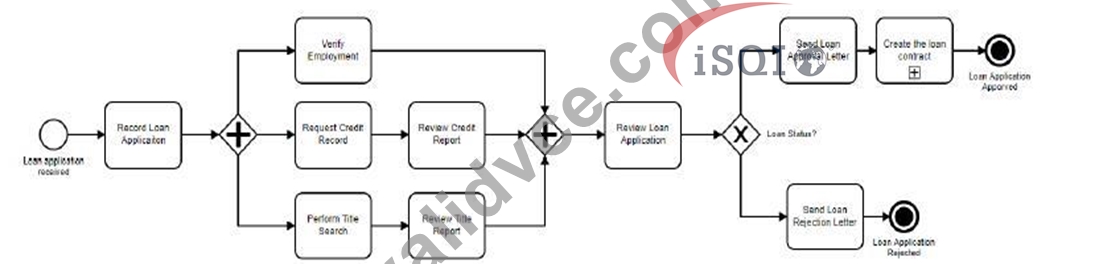
Which one of the following sentences is true with respect to this process model?
- A. Performing title search and requesting credit report are sequential tasks.
- B. Verifying employment is not done when the loan status is rejected.
- C. Creating the loan contract is defined as a sub-process.
- D. A review credit report is optional when reviewing the loan application.
Answer: C
NEW QUESTION # 39
Which of the following statements about test approaches and test techniques for acceptance testing is MOST correct?
- A. Code coverage and Test-Driven Development are generally combined with boundary value analysis in acceptance testing
- B. The refinement of requirements / user stories into acceptance criteria provides test conditions for the creation of acceptance tests
- C. If exploratory tests are performed, then there is no need to cover the acceptance criteria
- D. The review of user requirements / user stories and associated acceptance criteria avoids dynamic acceptance u testing
Answer: B
Explanation:
In ISTQB Acceptance Testing context, the process of refining requirements or user stories into acceptance criteria plays a crucial role in defining clear, testable conditions. These acceptance criteria act as the basis for deriving test conditions, which are in turn used to design acceptance test cases.
According to the ISTQB Foundation Level Acceptance Testing syllabus:
"Acceptance criteria are refined expressions of business requirements, and they help to determine the scope and intent of acceptance tests. These criteria are used to derive test conditions and guide the development of test cases." This alignment ensures that the delivered software meets the expectations set out in the requirements and satisfies the user needs. Acceptance tests are typically written from the user's perspective and are focused on verifying that the system behaves correctly in realistic business scenarios.
Option B is correct because it explicitly describes this logical and procedural relationship between user stories, acceptance criteria, and acceptance tests.
Other options are incorrect or misleading:
A is incorrect: reviewing requirements does not eliminate the need for dynamic testing.
C is incorrect: code coverage is more relevant for unit or system-level testing, not acceptance testing.
D is incorrect: exploratory testing is a valuable supplement but does not replace the need to verify acceptance criteria.
NEW QUESTION # 40
What is considered as good practice regarding business process modeling?
- A. Keeping all model element in one diagram considerably improves the readability of BMPN models.
- B. Business analysts should finalize their process models before showing them to acceptance testers.
- C. BPMN diagrams and DMN tables should include information such as traceability to user stories.
- D. Links to requirements or risks should be well separated from the workflow description.
Answer: C
Explanation:
Traceability is a key principle in requirements and test management. It ensures that all features, requirements, and tests are linked and accounted for. Including traceability to user stories in BPMN diagrams or DMN tables supports transparency, auditability, and maintenance.
Option B is correct because embedding or referencing traceability information within business models improves communication across stakeholders, ensures proper test coverage, and helps during change impact analysis.
Let's evaluate other options:
Option A is incorrect. Trying to place all model elements in one diagram can lead to cluttered and unreadable models.
Option C is misleading. While separation of concerns is useful, traceability (links to requirements, risks) should be integrated or closely accessible from the models.
Option D is incorrect. Acceptance testers should be involved early to collaborate and review models. Waiting until models are finalized contradicts agile and ATDD principles.
B). BPMN diagrams and DMN tables should include information such as traceability to user stories.
NEW QUESTION # 41
In Agile an exploratory test session is conducted. Which one of the following concepts applies BEST?
- A. planning poker
- B. timeboxing Answer
- C. pair programming
- D. refactoring
Answer: B
Explanation:
Exploratory testing in Agile projects is a structured but unscripted testing approach where learning, test design, and execution occur simultaneously. Timeboxing is a key practice in managing exploratory testing sessions effectively.
A timebox is a fixed duration (e.g., 60-90 minutes) within which testers explore specific functionalities or risks. It encourages focus, documentation of findings, and prevents overrun or testing fatigue. After the session, testers often hold debriefs to review findings and determine next steps.
Option D is correct because timeboxing is essential for exploratory testing management.
Incorrect options:
A). Pair programming relates to development, not testing.
B). Refactoring is a development technique focused on improving code without changing behavior.
C). Planning poker is used in Agile for effort estimation, not directly related to exploratory testing.
Exact Reference - ISTQB CTFL Acceptance Testing Syllabus (Section 3.1):
"Exploratory testing is often conducted in time-boxed sessions, with a charter guiding the scope of the session."
NEW QUESTION # 42
Which one of the following statements regarding ATDD / BDD is true?
- A. With visual ATDD, acceptance test cases are obtained from a graphical representation of application ^ workflows
- B. ATDD and BDD allow business analysts to code test automation scripts
- C. The concept of "living documentation" means that business requirements become executable
- D. In BDD, user stories are expressed in the form of Given - When - Then' statements
Answer: C
Explanation:
In BDD (Behavior-Driven Development) and ATDD (Acceptance Test-Driven Development), "living documentation" refers to executable acceptance criteria that are kept up to date throughout development.
These acceptance tests are written in natural, structured language (like Gherkin's Given-When-Then) and are linked directly to business requirements.
Option A is correct - "living documentation" bridges the gap between business and development by keeping requirements executable, relevant, and up to date.
Other options:
B is misleading - visual ATDD may use process models, but this is not a defining characteristic of BDD or ATDD.
C is true in part - BDD scenarios often use Given-When-Then, but this by itself is not the most defining statement when comparing options.
D is incorrect - ATDD and BDD support collaboration, but they do not expect business analysts to write code or automation scripts.
A). The concept of "living documentation" means that business requirements become executable
NEW QUESTION # 43
Which one of the following statements regarding ATDD / BDD is true?
- A. In Acceptance-Test Driven Development (ATDD., test cases are written prior to the acceptance criteria.
- B. In both Acceptance-Test Driven Development (ATDD. and Behavior-Driven Development (BDD., test cases provide examples of product use.
- C. Behavior-Driven Development (BDD. considers acceptance test design as an activity to be handled by the test team after requirements have been finalized.
- D. In both Acceptance-Test Driven Development (ATD and Behavior-Driven Development (BD, acceptance test cases are written by a test automation engineer as test automation code.
Answer: B
NEW QUESTION # 44
Which tool fits the mentioned acceptance test activities BEST?
- A. Requirements management tools for managing acceptance test execution campaigns.
- B. Test management and automation tools for business process model-based acceptance test generation.
- C. Model-based testing tools for managing incidents.
- D. Business process management tools for modeling business processes and rules.
Answer: D
NEW QUESTION # 45
Your company wants to establish a new human resources management application. As tester, you propose to use an ATDD approach and to use business process models for test case design.
Which of the following statements is the LEAST meaningful argument for this approach?
- A. Testers will be able to show test coverage directly within the graphical representation of business processes.
- B. As business process models will be updated to maintain the tests, they will be a living documentation of the product.
- C. Business process models will make it easier to detect defects in the application code.
- D. The process models will help testers to understand the use cases to be tested.
Answer: C
Explanation:
Acceptance Test-Driven Development (ATDD) involves early collaboration between stakeholders to define acceptance criteria and tests before development begins. Using business process models in ATDD helps visualize user behavior, align test cases with real workflows, and serve as living documentation.
Option C is the least meaningful argument because:
Business process models abstractly describe workflows and decisions at a business level. While they help clarify requirements and detect requirement-related defects, they do not directly support detecting defects in the application code, which is typically the focus of unit and integration testing, not acceptance testing.
Let's validate the other options:
A is a strong argument - process models clarify use cases for testers.
B is valid - graphical models help visualize test coverage directly.
D is true - as business process models evolve, they remain valuable artifacts aligned with current system behavior and requirements.
C). Business process models will make it easier to detect defects in the application code.
NEW QUESTION # 46
Which one of the following statements describes an exploratory test charter BEST?
- A. Indicating that the tester should take the role of a novice user can be part of an exploratory test charter.
- B. Acceptance testers use the exploratory test charter during the testing session to define the test oracle.
- C. Each exploratory test charter is based on a previously defined list of activities that would be interesting to test.
- D. The test charter is elaborated during the testing session according to test execution results.
Answer: A
NEW QUESTION # 47
As an acceptance tester, you are stuck between two stakeholders that demand contradicting acceptance criteria Which one of the following actions is MOST promising to resolve the conflict?
- A. You organize a meeting of the two stakeholders so that they can solve the conflict personally
- B. Instead of discussing conflicting technical solutions, you try to understand the underlying business needs
- C. Together with the business analyst, you determine which stakeholders is more important to decide between them
- D. After having collected the pros and cons of each solutions, you base your decision on those objective criteria
Answer: B
Explanation:
When stakeholders provide conflicting acceptance criteria, resolving the conflict effectively requires focusing on the underlying business goals rather than getting stuck in technical or solution-level disagreements.
Option D is correct because it aligns with the core role of a business analyst and an acceptance tester: to understand and validate business needs. By exploring the root business objectives, you can help stakeholders reframe the problem and reach a compromise based on what delivers the most value.
Other options:
A may lead to confrontation and unproductive discussion without proper facilitation.
B is risky - prioritizing stakeholders may escalate conflict or appear biased.
C assumes you can objectively resolve the conflict based only on pros and cons, but without understanding the business context, the decision may not meet stakeholder needs.
D). Instead of discussing conflicting technical solutions, you try to understand the underlying business needs
NEW QUESTION # 48
For a project to migrate an employee qualification management system to web technologies, the following requirement has been defined REQ 3-12 The system must be able to manage 3 types of users: HR team member with full rights, department manager with consultation and update rights only for members of his/her department, and employee with read-only access to his/her data Which of the following sentences BEST reflects an acceptable acceptance criterion?
- A. Since I am logged in as a department manager, when I try to access the file of an employee who is not in my department then a message telling me that I do not have access rights is displayed
- B. The list of employees who are members of a department can only be updated by a person logged as HR
- C. Security test must be performed to demonstrate that the authentication and rights management system is working properly
- D. The database must use MangoDB
Answer: A
Explanation:
Acceptance criteria should define how the system behaves for a given user story or requirement. They must be precise, testable, and directly traceable to the requirement being verified.
REQ 3-12 describes access control for three user types. Option B is a concrete, scenario-based acceptance criterion that tests the enforcement of access rights - making it an ideal match.
Other options:
A is irrelevant - database technology (MongoDB) is an implementation detail, not a functional criterion.
C is too vague - stating that security tests must be performed doesn't specify expected behavior or outcome.
D is plausible, but option B more directly demonstrates how an actual system behavior validates the requirement.
B). Since I am logged in as a department manager, when I try to access the file of an employee who is not in my department then a message telling me that I do not have access rights is displayed
NEW QUESTION # 49
In Agile an exploratory test session is conducted. Which one of the following concepts applies BEST?
- A. timeboxing
- B. planning poker
- C. pair programming
- D. refactoring
Answer: A
NEW QUESTION # 50
As a tester you participate in the project of the decision support system for granting a loan. You are asked to review the acceptance criteria for the following requirement:
REQ 3.28. The automated system records critical credit application data (CCAD. needed to support application screening.
Assume that it is well known what kind of data CCAD are. Which of the following would be the BEST example of an acceptance criterion for this requirement?
- A. The CCAD record process is quick and reversible.
- B. The process for collecting CCAD meets corporate usability guidelines.
- C. The CCAD are stored in the MySQL relational database after each successful data entry procedure.
- D. The CCAD is not recorded if it is incomplete and a message is displayed.
Answer: D
NEW QUESTION # 51
Which of the following statements BEST describes the relationship between beta testing and acceptance testing?
- A. Beta testing is a specific from of acceptance testing required for Commercial Off-the-Shelf Software
- B. Beta testing is often used for acceptance testing of Software as a Service (SaaS) platforms
- C. Beta testing and acceptance testing mean the same, but acceptance testing is the term used in Agile projects
- D. Beta testing and acceptance testing are distinct testing techniques and have nothing to do with each other
Answer: B
Explanation:
Beta testing is a type of acceptance testing performed by end users in a real-world or production-like environment. It is especially relevant for cloud-based and SaaS platforms where widespread feedback is required before release.
Option B is correct because SaaS platforms often release features to a subset of users (beta users) to test the software under actual operating conditions, get feedback, and fix any defects that were not found during internal testing. This allows vendors to validate functionality, performance, and usability in diverse environments.
Other options:
A: Beta testing is not limited to Commercial Off-the-Shelf (COTS) software.
C: Incorrect - beta testing is a form of acceptance testing, not a separate unrelated technique.
D: Incorrect - beta testing and acceptance testing overlap, but they are not synonyms; the terminology does not change based on the development approach (Agile or not).
B). Beta testing is often used for acceptance testing of Software as a Service (SaaS) platforms
NEW QUESTION # 52
In a project to develop an online booking system, the team decided to strengthen collaborative work between the business analyst and the testers working on the project. Several concrete joint activities have been identified.
- A. Definition of Beta Testing sessions
- B. Business needs assessment
- C. Review of risk to prioritize acceptance test
- D. Development of acceptance criteria for user stories
Answer: D
Explanation:
Collaboration between business analysts and testers is critical in Agile and acceptance testing environments.
One of the most effective areas of cooperation is the joint development and review of acceptance criteria for user stories. This ensures that criteria are testable, clearly defined, and aligned with stakeholder expectations.
Option B is correct because creating acceptance criteria is where both business analysts (who understand the business needs) and testers (who ensure testability and clarity) contribute effectively.
Other options:
A (Business needs assessment) is typically a responsibility of business analysts, not a joint activity with testers.
C (Review of risk to prioritize acceptance tests) is a valuable activity but comes after criteria are defined.
While it can be collaborative, it's more specific to test planning.
D (Definition of Beta Testing sessions) is less relevant to ongoing collaborative work between testers and BAs - this involves users and release planning.
B). Development of acceptance criteria for user stories
NEW QUESTION # 53
Which one of the following statements describes correctly how acceptance testing may be augmented with other test techniques or approaches?
- A. In a model-based testing approach, acceptance tests are generated from graphical or textual models.
- B. In a black-box testing approach, acceptance test scenarios follow the implemented sequence of function calls in the code.
- C. In a risk-based testing approach, acceptance criteria are derived from the tester's experience and intuition.
- D. In a priority-based testing approach, prioritization of acceptance tests depends on identified product risks.
Answer: A
NEW QUESTION # 54
......
One of the key benefits of taking the CTFL-AcT exam is that it provides a recognized and respected certification for acceptance testing professionals. ISTQB Foundation Level - Acceptance Testing certification is recognized by employers around the world and can help individuals stand out in a competitive job market. Additionally, the knowledge and skills gained through preparing for and taking the exam can enhance an individual's ability to contribute to their organization's software development efforts.
ISQI CTFL-AcT Real 2026 Braindumps Mock Exam Dumps: https://torrentpdf.validvce.com/CTFL-AcT-exam-collection.html
