

EC-COUNCIL 312-39 Daily Practice Exam New 2026 Updated 202 Questions
Use Valid 312-39 Exam - Actual Exam Question & Answer
EC-COUNCIL 312-39 (Certified SOC Analyst (CSA)) certification exam is designed to test a candidate's knowledge and skills in the field of Security Operations Center (SOC) analysis. Certified SOC Analyst (CSA) certification is ideal for individuals who are looking to advance their career in the security field and take on roles such as SOC analysts, incident response analysts, and threat hunters.
EC-COUNCIL 312-39 (Certified SOC Analyst (CSA)) Certification Exam is a globally recognized certification that is highly valued by employers in the IT and cybersecurity industry. Certified SOC Analyst (CSA) certification exam is designed to validate the skills and knowledge of professionals who are responsible for protecting organizations against cyber threats. Certified SOC Analyst (CSA) certification is an excellent way for professionals to demonstrate their expertise in SOC operations and to advance their careers in the cybersecurity field.
NEW QUESTION # 83
In which log collection mechanism, the system or application sends log records either on the local disk or over the network.
- A. pull-based
- B. signature-based
- C. push-based
- D. rule-based
Answer: C
Explanation:
In a push-based log collection mechanism, the system or application actively sends (or "pushes") log records to a designated storage location, which can be either on the local disk or over a network to a remote server.
This is in contrast to a pull-based mechanism, where the log records are retrieved (or "pulled") by the management server from the devices.
The push-based mechanism is often used for real-time monitoring and alerting because it allows for immediate transfer of log data as events occur. This method ensures that log records are consistently and reliably sent to a central repository without the need for a third-party service to request or retrieve them.
References: The EC-Council's Certified SOC Analyst (CSA) program includes the study of various log collection mechanisms as part of its curriculum. The CSA study materials provide detailed explanations of push-based and other log collection mechanisms, emphasizing their role in effective security operations center (SOC) monitoring and incident response. For further information, please refer to the official EC-Council CSA study guides and related course materials.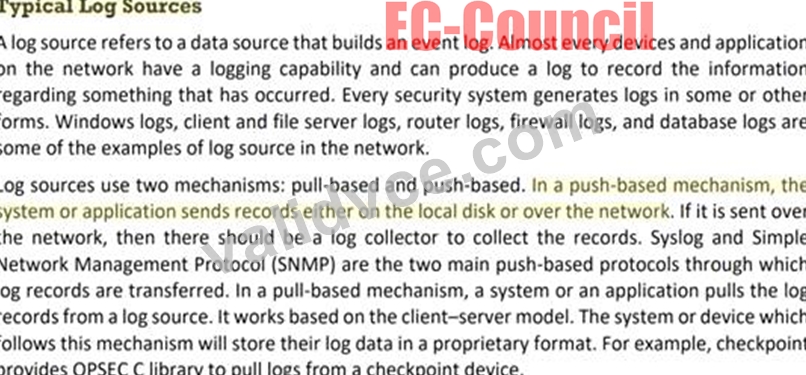
NEW QUESTION # 84
Which of the following contains the performance measures, and proper project and time management details?
- A. Incident Response Procedures
- B. Incident Response Tactics
- C. Incident Response Policy
- D. Incident Response Process
Answer: A
NEW QUESTION # 85
An attacker, in an attempt to exploit the vulnerability in the dynamically generated welcome page, inserted code at the end of the company's URL as follows:
http://technosoft.com.com/<script>alert("WARNING: The application has encountered an error");</script>.
Identify the attack demonstrated in the above scenario.
- A. Session Attack
- B. SQL Injection Attack
- C. Denial-of-Service Attack
- D. Cross-site Scripting Attack
Answer: D
Explanation:
The attack demonstrated in the scenario is a Cross-site Scripting (XSS) attack. This is evident from the attacker's action of inserting a <script> tag into the URL, which is a common technique used in XSS attacks to execute malicious scripts in the context of the victim's browser. The script in the URL is designed to display an alert box with a warning message, which is a typical behavior of XSS to show that the attacker can execute JavaScript in the user's browser session.
References The answer can be verified through EC-Council's Certified SOC Analyst (CSA) course materials and study guides, which cover various types of cyber attacks, including XSS, and their characteristics.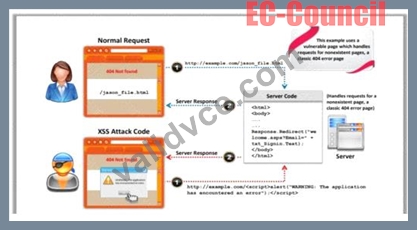
NEW QUESTION # 86
Jony, a security analyst, while monitoring IIS logs, identified events shown in the figure below.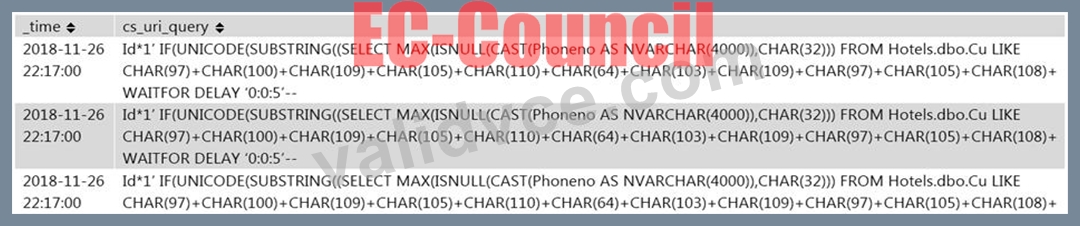
What does this event log indicate?
- A. XSS Attack
- B. Directory Traversal Attack
- C. SQL Injection Attack
- D. Parameter Tampering Attack
Answer: C
Explanation:
TheIIS log events indicate a SQL Injection Attack. This is evident from the complex SQL queries present in the log, which include functions like "UNICODE", "SUBSTRING", and "MAX". These functions are being used in a manner that suggests manipulation of strings and extraction of data, which are common tactics in SQL injection attacks. The use of specific characters like CHAR(97) and CHAR(108) within the queries is a technique often employed to bypass security mechanisms during such attacks.
References: For further study and verification, the EC-Council's Certified SOC Analyst (CSA) course materials and study guides provide extensive information on identifying and responding to various types of cyber attacks, including SQL Injection. These resources are essential for any security analyst to understand the intricacies of log analysis and attack identification.
NEW QUESTION # 87
James Rodriguez has recently taken over as the lead SOC manager at GlobalTech Dynamics. The team is deploying a $2M SOC facility, creating incident response playbooks, running tabletop exercises, and training a 15-member incident response team to handle alerts and incidents efficiently. In the Incident Response process flow, which phase best aligns with these activities?
- A. Preparation
- B. Incident triage
- C. Incident recording and assignment
- D. Recovery
Answer: A
Explanation:
These activities fall under Preparation because they are about building readiness before incidents occur.
Preparation includes developing and documenting playbooks, establishing tooling and infrastructure (SOC facility, monitoring platforms), training staff, defining roles and escalation paths, and exercising procedures through tabletop simulations. The goal is to ensure that when incidents happen, the SOC and incident response teams can respond quickly, consistently, and effectively. Recovery occurs after an incident to restore systems. Incident recording and assignment is the operational step of logging and routing a specific incident.
Incident triage is the rapid assessment of a specific alert to determine severity and next actions. None of those are the focus here; the scenario is clearly about capability building and readiness. From a SOC maturity perspective, strong preparation reduces response time, minimizes confusion during high-stress events, improves coordination across teams, and enhances compliance posture by demonstrating that the organization has defined and tested incident handling procedures.
NEW QUESTION # 88
A large financial services company has experienced increasing sophisticated threats targeting critical assets.
The SOC primarily focuses on log collection and basic monitoring, but incidents revealed gaps in detecting and responding to advanced threats proactively. Management decides to adopt the SOC Capability Maturity Model (CMM). The initial assessment indicates the SOC is at Level 1, and the organization aims to reach Level 3 by enhancing incident response procedures, improving threat intelligence integration, establishing KPIs, automating triage, implementing behavior-based analytics, and creating continuous training. Based on the SOC CMM, what should be the first priority in transitioning from Level 1 to Level 3?
- A. Deploying advanced deception technologies
- B. Establishing well-defined and repeatable incident response processes
- C. Outsourcing SOC operations to an MSSP
- D. Implementing AI-driven automation for real-time detection and response
Answer: B
Explanation:
Moving from a low-maturity SOC to a more capable, repeatable operation requires a stable operational foundation before advanced technology layers. Establishing well-defined and repeatable incident response processes is the correct first priority because it creates consistency in how alerts are triaged, escalated, contained, investigated, and documented. At Level 1, organizations often operate ad hoc: inconsistent handoffs, unclear severity criteria, and weak documentation. Without standardized processes and playbooks, adding AI automation or deception technologies can amplify confusion or trigger disruptive actions based on poorly understood signals. Repeatable IR processes also enable measurement-KPIs like MTTA/MTTR, false positive rates, and containment effectiveness-which is essential to progress to Level 3 maturity. Threat intelligence integration and behavior analytics become far more effective when the SOC has defined workflows to consume intelligence, update detections, and execute response steps predictably. Outsourcing is a resourcing model choice rather than a maturity prerequisite. Therefore, the first step is building structured, documented, consistently executed incident response procedures that create the platform for tuning, automation, and advanced analytics.
NEW QUESTION # 89
What does HTTPS Status code 403 represents?
- A. Unauthorized Error
- B. Internal Server Error
- C. Forbidden Error
- D. Not Found Error
Answer: C
Explanation:
The HTTPS status code 403 represents a Forbidden Error. This error occurs when the server understands the request but refuses to authorize it. Unlike the Unauthorized Error (401), which suggests that the request might be authorized if the client re-authenticates, the Forbidden Error indicates that re-authenticating will make no difference and access is denied regardless of authentication status.
The Forbidden Error is tied to the application logic, such as insufficient rights to a resource or the server being programmed to deny access to a particular resource to the client. It is not related to the client's credentials but rather to the permissions set by the server for the requested resource.
References: The EC-Council SOC Analyst course materials and study guides discuss various HTTP status codes as part of understanding web application security and interpreting web logs within a Security Operations Center (SOC) context. The materials explain the meaning of the 403 Forbidden Error and its implications for cybersecurity analysis123.
Reference: https://en.wikipedia.org/wiki/HTTP_403
NEW QUESTION # 90
Which of the following security technology is used to attract and trap people who attempt unauthorized or illicit utilization of the host system?
- A. Intrusion Detection System
- B. Firewall
- C. Honeypot
- D. De-Militarized Zone (DMZ)
Answer: C
Explanation:
A honeypot is a security mechanism that serves as a decoy to attract and trap individuals attemptingunauthorized or illicit activities. It is designed to mimic a real system that appears vulnerable and valuable to attackers. The primary purpose of a honeypot is to distract attackers from legitimate targets, gather intelligence on attack strategies and behavior, and ultimately improve the overall security posture by learning from the attacks it captures.
* Attraction: The honeypot presents itself as an attractive target to potential attackers by simulating vulnerabilities.
* Engagement: Once theattackers engage with the honeypot, their activities are monitored and logged without their knowledge.
* Analysis: The data collected from these interactions is then analyzed to understand attack patterns, techniques, and goals.
* Improvement: This intelligence is used to enhance security measures, such as updating firewall rules or improving intrusion detection systems.
References:
The EC-Council's Certified SOC Analyst (CSA) program includes training on various security technologies, including honeypots, as part of its curriculum to prepare individuals for roles in Security Operations Centers (SOC)1.
EC-Council's resources on cybersecurity also provide detailed explanations of honeypots, their purposes, and their implementation within a cybersecurity framework2.
Additionally, the role of a SOC Analyst often involves understanding and potentially deploying honeypots as part of a broader security strategy3.
Reference: https://www.kaspersky.com/resource-center/threats/what-is-a-honeypot
NEW QUESTION # 91
Which attack works like a dictionary attack, but adds some numbers and symbols to the words from the dictionary and tries to crack the password?
- A. Hybrid Attack
- B. Bruteforce Attack
- C. Rainbow Table Attack
- D. Birthday Attack
Answer: A
Explanation:
A Hybrid Attack is a type of cyber attack that combines elements of a dictionary attack with a brute force attack. It involves taking words from a dictionary (which could be a list of common passwords or related words) and augmenting them with numbers and symbols to generate potential passwords. This method increases the chances of cracking a password by including the common variations that users often add to their passwords to meet complexity requirements.
References: The EC-Council's Certified SOC Analyst (CSA) resources describe various types of attacks and their methodologies. According to these resources, a Hybrid Attack specifically refers to this combined approach, which is more sophisticated than a simple dictionary attack and is designed to overcome the limitations of dictionary attacks by including additional characters1.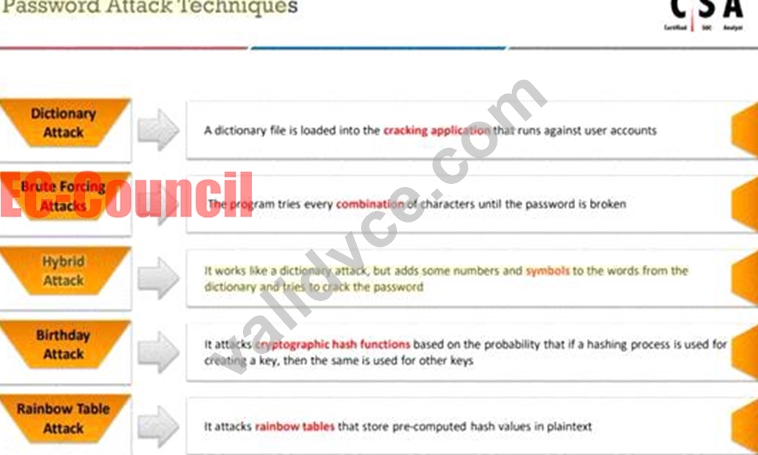
NEW QUESTION # 92
Which of the following technique protects from flooding attacks originated from the valid prefixes (IP addresses) so that they can be traced to its true source?
- A. Egress Filtering
- B. Rate Limiting
- C. Ingress Filtering
- D. Throttling
Answer: C
NEW QUESTION # 93
Which of the following steps of incident handling and response process focus on limiting the scope and extent of an incident?
- A. Identification
- B. Eradication
- C. Data Collection
- D. Containment
Answer: D
NEW QUESTION # 94
A type of threat intelligent that find out the information about the attacker by misleading them is known as
.
- A. Threat trending Intelligence
- B. Counter Intelligence
- C. Operational Intelligence
- D. Detection Threat Intelligence
Answer: C
NEW QUESTION # 95
Wesley is an incident handler in a company named Maddison Tech. One day, he was learning techniques for eradicating the insecure deserialization attacks.
What among the following should Wesley avoid from considering?
- A. Allow serialization for security-sensitive classes
- B. Understand the security permissions given to serialization and deserialization
- C. Deserialization of trusted data must cross a trust boundary
- D. Validate untrusted input, which is to be serialized to ensure that serialized data contain only trusted classes
Answer: A
Explanation:
Insecure deserialization often leads to critical vulnerabilities allowing attackers to perform various attacks, such as remote code execution. To mitigate these vulnerabilities, Wesley should avoid considering the serialization of security-sensitive classes because it can expose sensitive data to untrusted sources or lead to arbitrary code execution.
Here are the steps Wesley should follow:
* Avoid Serialization of Sensitive Data: Do not serialize sensitive information. If it's essential to serialize, then ensure it's encrypted and the process is secure.
* Implement Integrity Checks: Use digital signatures or checksums to verify that the serialized data has not been tampered with before deserializing it.
* Enforce Strict Type Constraints: When deserializing, ensure that the data adheres to strict type constraints to prevent the instantiation of unexpected types.
* Logging and Monitoring: Keep detailed logs of serialization and deserialization processes to monitor for any suspicious activities.
* Security Controls Review: Regularly review and update security controls related to serialization and deserialization to ensure they are effective against emerging threats.
References:
* EC-Council's Certified SOC Analyst (CSA) program provides extensive training on how to handle various cybersecurity threats, including insecure deserialization12.
* The CSA certification emphasizes the importance of understanding the security risks associated with serialization and deserialization and implementing best practices to mitigate these risks12.
* Additional resources and study guides from EC-Council's official materials on the Certified SOC Analyst (CSA) program would provide more in-depth strategies and practices for handling insecure deserialization attacks12.
NEW QUESTION # 96
Juliea a SOC analyst, while monitoring logs, noticed large TXT, NULL payloads.
What does this indicate?
- A. Covering Tracks Attempt
- B. DNS Exfiltration Attempt
- C. DHCP Starvation Attempt
- D. Concurrent VPN Connections Attempt
Answer: B
Explanation:
Juliea, the SOC analyst, noticed large TXT and NULL payloads in the logs. This is indicative of a DNS exfiltration attempt. DNS exfiltration is a type of cyber attack where an attacker uses the DNS protocol to sneak data out of a network undetected. It typically involves the use of large TXT records, which can be used to carry data out of the network. NULL payloads can be used in this context to pad the DNS queries and make them less suspicious or to bypass security controls that inspect the content of DNS queries.
The steps involved in DNS exfiltration include:
* The attacker compromises a system within the target network.
* Malware on the compromised system encodes the data it wants to exfiltrate.
* The encoded data is split into chunks that fit into DNS query sizes.
* These chunks are sent as data in DNS queries or responses, often using TXT records.
* An external attacker-controlled server receives the DNS queries and decodes the data.
References:
* EC-Council's Certified SOC Analyst (CSA) course material and study guides provide detailed information on various types of cyber attacks, including DNS exfiltration.
* Online resources and practice questions for the Certified SOC Analyst (CSA) exam also cover this topic and can be used to verify the answer123.
* Additional information on DNS exfiltration techniques and detection methods can be found in security blogs and articles that discuss the subject in depth456.
NEW QUESTION # 97
Which of the following command is used to enable logging in iptables?
- A. $ iptables -B OUTPUT -j LOG
- B. $ iptables -A INPUT -j LOG
- C. $ iptables -B INPUT -j LOG
- D. $ iptables -A OUTPUT -j LOG
Answer: B
Explanation: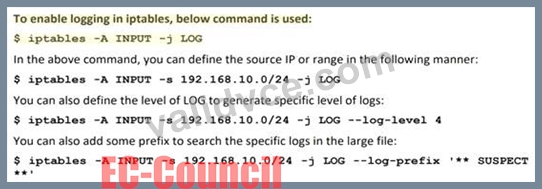
NEW QUESTION # 98
An organization with a complex IT infrastructure is planning to implement a SIEM solution to improve its threat detection and response capabilities. Due to the scale and complexity of its systems, the organization opts for a phased deployment approach to ensure a smooth implementation and reduce potential risks. Which of the following should be the first phase in their SIEM deployment strategy?
- A. Set up the log management component before deploying the SIEM component
- B. Automate incident response processes
- C. Configure security analytics to identify potential threats
- D. Implement User and Entity Behavior Analytics (UEBA)
Answer: A
Explanation:
The first phase should establish reliable log ingestion and storage-log management-before attempting advanced detection content or automation. A SIEM is only as effective as the data it receives. In a complex environment, initial success depends on building a stable pipeline: collecting logs from priority sources, normalizing timestamps, ensuring consistent parsing, defining retention, and validating data quality (completeness, latency, duplication, and integrity). Without this foundation, analytics will produce blind spots, false positives, and missed detections, and automation may take disruptive actions based on incomplete data. UEBA and security analytics are valuable but require sufficient historical, high-quality telemetry to build baselines and correlations. Similarly, incident response automation should come after the organization has validated detections, tuning, and operational workflows; otherwise, playbooks may amplify errors at scale. A phased approach typically starts with identifying key data sources (identity, endpoint, network, cloud), onboarding them into log management, confirming visibility and schema consistency, and only then layering detection rules, correlations, and response workflows. Therefore, setting up log management first is the correct starting phase for a low-risk, high-success SIEM deployment.
NEW QUESTION # 99
Which of the following formula is used to calculate the EPS of the organization?
- A. EPS = average number of correlated events / time in seconds
- B. EPS = number of security events / time in seconds
- C. EPS = number of correlated events / time in seconds
- D. EPS = number of normalized events / time in seconds
Answer: C
Explanation:
In the context of a Security Operations Center (SOC), EPS typically refers to "Events Per Second," which is a measure of the number of security events processed in one second. The correct formula for calculating EPS in a SOC environment is the number of correlated events divided by the time in seconds. Correlated events are those that have been analyzed and aggregated by the SOC's security information and event management (SIEM) system, indicating a potential security incident. This metric helps in understanding the operational load and performance of the SOC.
References: The information is aligned with the EC-Council's Certified SOC Analyst (CSA) course material and best practices, which emphasize the importance of understanding and managing SOC operational metrics such as EPS for effective security monitoring and incident response12.
NEW QUESTION # 100
Daniel is a member of an IRT, which was started recently in a company named Mesh Tech. He wanted to find the purpose and scope of the planned incident response capabilities.
What is he looking for?
- A. Incident Response Vision
- B. Incident Response Intelligence
- C. Incident Response Mission
- D. Incident Response Resources
Answer: C
Explanation: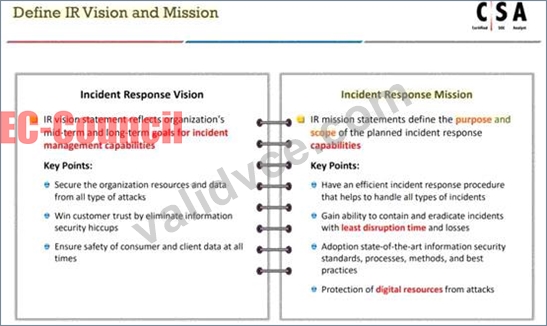
NEW QUESTION # 101
Which of the following event detection techniques uses User and Entity Behavior Analytics (UEBA)?
- A. Signature-based detection
- B. Anomaly-based detection
- C. Rule-based detection
- D. Heuristic-based detection
Answer: B
NEW QUESTION # 102
According to the Risk Matrix table, what will be the risk level when the probability of an attack is very high, and the impact of that attack is major?
NOTE: It is mandatory to answer the question before proceeding to the next one.
- A. Low
- B. Medium
- C. High
- D. Extreme
Answer: D
Explanation:
In a Risk Matrix, risk levels are determined by the intersection of the likelihood of anoccurrence (probability) and the consequence of that occurrence (impact). When the probability of an event is very high and the impact is major, it typically falls into the 'Extreme' category. This is because the combination of a high likelihood and major impact represents a scenario where the risk is unacceptable and requires immediate attention and mitigation measures.
References: The EC-Council's Certified SOC Analyst (CSA) course materials and study guides provide detailed information onassessing risks using a Risk Matrix. The course emphasizes the importance of understanding the Risk Matrix for effective security operations center (SOC) analysis. For more in-depth information, refer to the official EC-Council CSA study materials and resources12.
Reference: https://onlinelibrary.wiley.com/page/journal/15396924/homepage/ special_issue simple_characterisations_and_communication_of_risks.htm
NEW QUESTION # 103
According to the Risk Matrix table, what will be the risk level when the probability of an attack is very high, and the impact of that attack is major?
NOTE: It is mandatory to answer the question before proceeding to the next one.
- A. Low
- B. Medium
- C. High
- D. Extreme
Answer: D
Explanation:
In a Risk Matrix, risk levels are determined by the intersection of the likelihood of an occurrence (probability) and the consequence of that occurrence (impact). When the probability of an event is very high and the impact is major, it typically falls into the 'Extreme' category. This is because the combination of a high likelihood and major impact represents a scenario where the risk is unacceptable and requires immediate attention and mitigation measures.
References: The EC-Council's Certified SOC Analyst (CSA) course materials and study guides provide detailed information on assessing risks using a Risk Matrix. The course emphasizes the importance of understanding the Risk Matrix for effective security operations center (SOC) analysis. For more in-depth information, refer to the official EC-Council CSA study materials and resources12.
NEW QUESTION # 104
John as a SOC analyst is worried about the amount of Tor traffic hitting the network. He wants to prepare a dashboard in the SIEM to get a graph to identify the locations from where the TOR traffic is coming.
Which of the following data source will he use to prepare the dashboard?
- A. DNS/ Web Server logs with IP addresses.
- B. DHCP/Logs capable of maintaining IP addresses or hostnames with IPtoName resolution.
- C. Apache/ Web Server logs with IP addresses and Host Name.
- D. IIS/Web Server logs with IP addresses and user agent IPtouseragent resolution.
Answer: B
Explanation:
To monitor and visualize Tor traffic hitting the network, John would need data sources that can provide detailed information about the source IP addresses of incoming traffic, as well as the capability to resolve these IP addresses to more identifiable information such as hostnames or geographical locations. DHCP logs, or other log sources capable of maintaining detailed IP address records and facilitating IP-to-Name resolution, would be suitable for this purpose. This data would allow John to create a dashboard in the SIEM system that maps the source IP addresses of Tor traffic to their corresponding locations or identities, providing insights into where the Tor traffic is originating. While web server logs (options B, C, and D) can provide IP addresses, they might not offer the same level of detail or resolution capabilities as DHCP logs or similar network-level logs for this specific use case.
References:
* "Logging and Log Management: The Authoritative Guide to Understanding the Concepts Surrounding Logging and Log Management" by Anton Chuvakin, Kevin Schmidt, and Chris Phillips.
* "Tor: The Second-Generation Onion Router" by Roger Dingledine, Nick Mathewson, and Paul Syverson.
NEW QUESTION # 105
Which of the log storage method arranges event logs in the form of a circular buffer?
- A. FIFO
- B. non-wrapping
- C. LIFO
- D. wrapping
Answer: A
NEW QUESTION # 106
Which of the following Windows features is used to enable Security Auditing in Windows?
- A. Windows Defender
- B. Local Group Policy Editor
- C. Bitlocker
- D. Windows Firewall
Answer: B
NEW QUESTION # 107
......
EC-COUNCIL 312-39 exam is recognized by many organizations and companies around the world, including government agencies, financial institutions, and multinational corporations. Certified SOC Analyst (CSA) certification is highly valued by employers, as it demonstrates that the candidate has the skills and knowledge needed to protect their organization's assets and data from cyber threats. Additionally, having this certification can help professionals command higher salaries and advance their careers in the cybersecurity field.
Test Engine to Practice 312-39 Test Questions: https://torrentpdf.validvce.com/312-39-exam-collection.html
