

Free SSE-Engineer pdf Files With Updated and Accurate Dumps Training
Top-Class SSE-Engineer Question Answers Study Guide
NEW QUESTION # 28
A customer is implementing Prisma Access (Managed by Strata Cloud Manager) to connect mobile users, branch locations, and business-to- business (B2B) partners to their data centers.
The solution must meet these requirements:
The mobile users must have internet filtering, data center connectivity, and remote site connectivity to the branch locations.
The branch locations must have internet filtering and data center connectivity.
The B2B partner connections must only have access to specific data center internally developed applications running on non-standard ports.
The security team must have access to manage the mobile user and access to branch locations.
The network team must have access to manage only the partner access.
Which two options will allow the engineer to support the requirements? (Choose two.)
- A. Enable Remote Networks Advertise Default Route.
- B. Configure the CPE with Static Routes pointing to Prisma Access Infrastructure and Mobile User routes.
- C. Configure Remote Networks and define the branch IP subnets using Static Routes.
- D. Enable eBGP for dynamic routing and configure RemoteNetworks.
Answer: C,D
Explanation:
Enabling eBGP for dynamic routing and configuring Remote Networks ensures seamless connectivity between branch locations, mobile users, and the data center. eBGP allows Prisma Access to dynamically exchange routes with the Customer Premises Equipment (CPE), optimizing path selection without requiring manual updates. Configuring Remote Networks and defining branch IP subnets using static routes ensures controlled and segmented routing, aligning with security policies. This setup provides proper internet filtering, data center connectivity, and restricted access for B2B partners while keeping management responsibilities aligned.
NEW QUESTION # 29
A user connected to Prisma Access reports that traffic intermittently is denied after matching a Catch-All Deny rule at the bottom and bypassing HIP-based policies. Refreshing VPN connection restores the access.
What are two reasons for this behavior? (Choose two.)
- A. Firewall loses user mapping due to missed HIP report checks.
- B. "Collect HIP data' needs to be enabled in the configuration.
- C. HIP-enforced policy is scheduled for certain hours of the day.
- D. User mapping is learned from sources other than gateway authentication.
Answer: A,D
Explanation:
User mapping learned from sources other thangateway authenticationcan cause intermittent access issues if it conflicts with the expected user identity used in HIP-based policies. If the firewall is associatingthe user with an outdated or incorrect mapping, traffic may not match the intended security policies, leading todenials by the Catch-All Deny rule.
If thefirewall loses user mapping due to missed HIP report checks, the user may temporarily lose access to policies that require a validHost Information Profile (HIP)match. When the VPN connection is refreshed, the HIP check is re-initiated, restoring access until the issue repeats.
NEW QUESTION # 30
Which two statements apply when a customer has a large branch office with employees who all arrive and log in within a five-minute time period? (Choose two.)
- A. Maximum number of TCP DNS retries is 3.
- B. DNS results are only cached for frequently used hostnames.
- C. DNS results are cached for 300 seconds.
- D. Maximum pending TCP DNS requests is 64.
Answer: A,D
Explanation:
When a large branch office experiences a high volume of employees logging in within a short time frame, the following apply:
* Maximum pending TCP DNS requests is 64- This means that Prisma Access can queue up to 64 pending DNS requests over TCP before dropping additional requests. If more requests are received simultaneously, some may fail or experience delays.
* Maximum number of TCP DNS retries is 3- If a DNS request fails over TCP, Prisma Access will attempt to retry the request up to three times before failing over to another method or returning an error.
NEW QUESTION # 31
Which Cloud Identity Engine capability will create a Security policy that uses Entra ID attributes as the source identification?
- A. Attribute Group Mapping
- B. Cloud Dynamic User Group
- C. Entra ID Cloud Group
- D. Entra ID Group Attribute
Answer: B
Explanation:
TheCloud Dynamic User Groupcapability inCloud Identity Engineenables the creation ofSecurity policies that useEntra ID (formerly Azure AD) attributesfor user identification. This allows PrismaAccess to dynamically applyuser-based security rulesbased onreal-time Entra ID attributes, ensuring that access policies adapt to user changes such asgroup membership, device compliance, or role updates.
NEW QUESTION # 32
An intern is tasked with changing the Anti-Spyware Profile used for security rules defined in the GlobalProtect folder. All security rules are using the Default Prisma Profile. The intern reports that the options are greyed out and cannot be modified when selecting the Default Prisma Profile.
Based on the image below, which action will allow the intern to make the required modifications?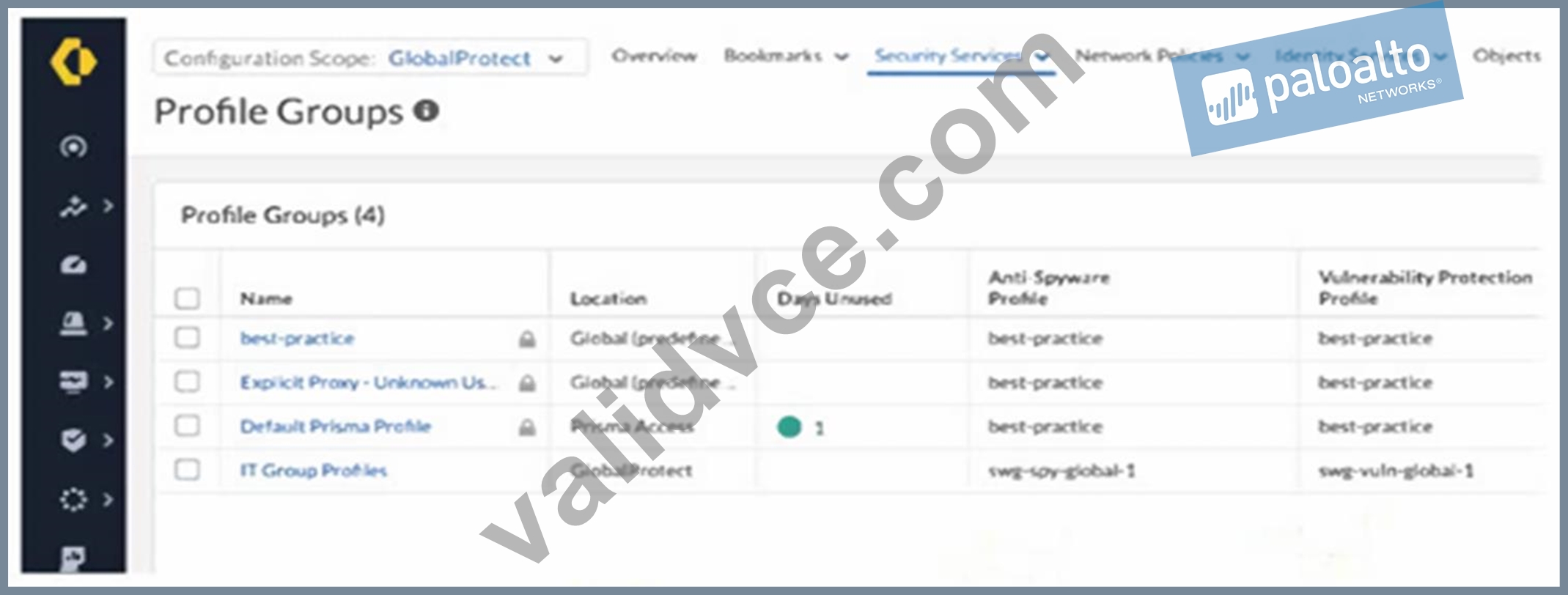
- A. Modify the existing anti-spyware profile, because best-practice profiles cannot be removed from a group.
- B. Create a new profile, because default profile groups cannot be modified.
- C. Request edit access for the GlobalProtect scope.
- D. Change the configuration scope to Prisma Access and modify the profile group.
Answer: B
Explanation:
Palo Alto Networks best practices and the behavior of Strata Cloud Manager (SCM) dictate thatpredefined or default objects, including profile groups like "Default Prisma Profile," cannot be directly modified.
These default objects serve as baseline configurations and are often locked to prevent accidental or unintended changes that could impact the overall security posture.
The intern's experience of the options being greyed out when selecting "Default Prisma Profile" is a direct indication of this immutability of default objects.
Therefore, the correct action is to:
* Create a new Profile Group:The intern should create a new profile group within the appropriate configuration scope (likely GlobalProtect, given the task).
* Configure the new Profile Group:In this new profile group, the intern can select the desired Anti- Spyware Profile (which might be an existing custom profile or a new one they create).
* Modify Security Rules:The security rules currently using the "Default Prisma Profile" in the GlobalProtect folder need to be modified to use this newly created profile group.
Let's analyze why the other options are incorrect based on official documentation:
* A. Request edit access for the GlobalProtect scope.While having the correct scope permissions is necessary for makinganychanges within GlobalProtect, it will not override the inherent immutability of default objects like "Default Prisma Profile." Edit access will allow the intern to create new objects and modify rules, but not directly edit the default profile group.
* B. Change the configuration scope to Prisma Access and modify the profile group.The image shows that "Default Prisma Profile" has a "Location" of "Prisma Access." However, even within the Prisma Access scope, default profile groups are generally not directly editable. The issue is not the scope but the fact that it's a default object.
* D. Modify the existing anti-spyware profile, because best-practice profiles cannot be removed from a group.The question is about changing theprofile group, not the individual Anti-Spyware Profile. While "best-practice" profiles might be part of default groups, the core issue is the inability to modify thedefault groupitself. Creating a new group allows the intern to choose which Anti-Spyware Profile to include.
In summary, the fundamental principle in Palo Alto Networks management is that default objects are typically read-only to ensure a consistent and predictable baseline. To make changes, you need to create custom objects.
NEW QUESTION # 33
A customer using Prisma Access (Managed by Panorama) wants to monitor traffic patterns across all remote networks and use Strata Logging Service to gather insights on network usage. An engineer notices that some network data is missing from the Application Command Center (ACC).
What should the engineer do to ensure complete data visibility?
- A. Ensure that log forwarding profiles are applied to all Prisma Access policies and directed to Strata Logging Service.
- B. Reconfigure the Prisma Access remote networks to log directly to Panorama instead of using Strata Logging Service.
- C. Enable the Use Data for Pre-Defined Reports' setting in the Logging and Reporting configuration on Panorama.
- D. Verify that the Panorama web interface has been configured to aggregate logs from both the Panorama data and RN-SPNs.
Answer: A
Explanation:
For complete data visibility inPrisma Access (Managed by Panorama),log forwarding profilesmust be applied toall security policiesto ensure that traffic logs are correctly sent toStrata Logging Service. If log forwarding is missing or misconfigured, some traffic data may not appear in theApplication Command Center (ACC), leading to incomplete insights. Verifying and correctly assigning log forwarding ensures that all relevant network activity is captured and available for analysis.
NEW QUESTION # 34
A customer is implementing Prisma Access (Managed by Strata Cloud Manager) to connect mobile users, branch locations, and business-to- business (B2B) partners to their data centers.
The solution must meet these requirements:
The mobile users must have internet filtering, data center connectivity, and remote site connectivity to the branch locations.
The branch locations must have internet filtering and data center connectivity.
The B2B partner connections must only have access to specific data center internally developed applications running on non-standard ports.
The security team must have access to manage the mobile user and access to branch locations.
The network team must have access to manage only the partner access.
How should Prisma Access be implemented to meet the customer requirements?
- A. Deploy a Prisma Access instance with mobile users, remote networks, and private access for all connection types, and use the specific configuration scope for the connection type to manage access.
- B. Deploy two Prisma Access instances - the first with mobile users, remote networks, and private access for all internal connection types, and the second with remote networks and private application access for B2B connections - and use the specific configuration scope for the connection type to manage access.
- C. Deploy a Prisma Access instance with mobile users, remote networks, and private access for all connection types, and use the Prisma Access Configuration scope to manage all access.
- D. Deploy two Prisma Access instances - the first with mobile users, remote networks, and private access for all internal connection types, and the second with remote networks and private application access for B2B connections - and use the Strata Multitenant Cloud Manager Prisma Access configuration scope to manage access.
Answer: B
Explanation:
To meet the customer's requirements, two separate Prisma Access instances should be deployed:
* Instance 1should includemobile users, remote networks, and private accessfor internal connectivity.
This ensures that mobile users can access the internet, data centers, and remote branch locations while enforcing security policies.
* Instance 2should be configured withremote networks and private application accessfor B2B connections. This instance will restrict access to only the required internally developed applications using non-standard ports, ensuring that partners cannot access other corporate resources.
By usingspecific configuration scopes for different connection types, the security team can manage access to mobile users and branch locations, while the network team can manage B2B partner connections. This ensuresproper segmentation of management responsibilitieswhile maintaining security and compliance.
NEW QUESTION # 35
A customer is implementing Prisma Access (Managed by Strata Cloud Manager) to connect mobile users, branch locations, and business-to- business (B2B) partners to their data centers.
* The solution must meet these requirements:
* The mobile users must have internet filtering, data center connectivity, and remote site connectivity to the branch locations.
* The branch locations must have internet filtering and data center connectivity.
* The B2B partner connections must only have access to specific data center internally developed applications running on non-standard ports.
* The security team must have access to manage the mobile user and access to branch locations.
* The network team must have access to manage only the partner access.
Which two components can be provisioned to enable data center connectivity over the internet? (Choose two.)
- A. ZTNA Connector
- B. SD-WAN Connector
- C. Service connections
- D. Colo-Connect
Answer: C,D
Explanation:
Service connections enable secure connectivity between Prisma Access and on-premises data centers, allowing mobile users and branch locations to access internal applications. They facilitate seamless integration of internal networks with Prisma Access while maintaining security policies. Colo-Connect provides a dedicated and optimized pathway for traffic between Prisma Access and data centers, ensuring stable performance and reduced latency over the internet. Both components together support secure and efficient data center connectivity while aligning with the customer's access control and filtering requirements.
NEW QUESTION # 36
An engineer has configured IPSec tunnels for two remote network locations; however, users are experiencing intermittent connectivity issues across the tunnels.
What action will allow the engineer to receive notifications when the IPSec tunnels are down or experiencing instability?
- A. Select the IPSec tunnel monitoring and notifications checkbox when configuring the remote network IPSec tunnels.
- B. Set up the operational health dashboard to email alerts for remote Network IPSec tunnel issues.
- C. Create a tunnel log notification rule to alert on specified remote network IPSec tunnel conditions.
- D. Create a new notification profile specifying conditions for remote network IPSec tunnels.
Answer: D
Explanation:
InPrisma Access, configuring anotification profileallows engineers to receive alerts when IPSec tunnels experience downtime or instability. By definingspecific conditions for remote network IPSec tunnels, the notification profile ensures that the engineer is proactively informed abouttunnel failures, flapping, or degraded performance. This approach enables timely troubleshooting and minimizes disruptions for users relying on the IPSec tunnels.
NEW QUESTION # 37
A customer is implementing Prisma Access (Managed by Strata Cloud Manager) to connect mobile users, branch locations, and business-to- business (B2B) partners to their data centers.
* The solution must meet these requirements:
* The mobile users must have internet filtering, data center connectivity, and remote site connectivity to the branch locations.
* The branch locations must have internet filtering and data center connectivity.
* The B2B partner connections must only have access to specific data center internally developed applications running on non-standard ports.
* The security team must have access to manage the mobile user and access to branch locations.
* The network team must have access to manage only the partner access.
Which two components can be provisioned to enable data center connectivity over the internet? (Choose two.)
- A. ZTNA Connector
- B. SD-WAN Connector
- C. Service connections
- D. Colo-Connect
Answer: C,D
Explanation:
Service connections enable secure connectivity between Prisma Access and on-premises data centers, allowing mobile users and branch locations to access internal applications. They facilitate seamless integration of internal networks with Prisma Access while maintaining security policies. Colo-Connect provides a dedicated and optimized pathway for traffic between Prisma Access and data centers, ensuring stable performance and reduced latency over the internet. Both components together support secure and efficient data center connectivity while aligning with the customer's access control and filtering requirements.
NEW QUESTION # 38
Which statement is valid in relation to certificates used for GlobalProtect and pre-logon?
- A. The GlobalProtect agent may be used to distribute pre-logon certificates.
- B. Certificates must be deployed in the Machine Certificate Store.
- C. The certificate used for pre-logon must include both Subject and Subject-Alt fields.
- D. A public certificate authority (CA) must sign and validate all certificates used.
Answer: B
Explanation:
ForGlobalProtect with pre-logon, certificates must beinstalled in the Machine Certificate Storeto ensure that authentication occursbefore user login. This allows the GlobalProtect client to establish aVPN connection before the user logs in, enabling access to corporate resources such as domain controllers and authentication services. Usingmachine certificatesensures secure authentication and eliminates dependency on user credentials at the pre-logon stage.
NEW QUESTION # 39
A customer is implementing Prisma Access (Managed by Strata Cloud Manager) to connect mobile users, branch locations, and business-to- business (B2B) partners to their data centers.
The solution must meet these requirements:
The mobile users must have internet filtering, data center connectivity, and remote site connectivity to the branch locations.
The branch locations must have internet filtering and data center connectivity.
The B2B partner connections must only have access to specific data center internally developed applications running on non-standard ports.
The security team must have access to manage the mobile user and access to branch locations.
The network team must have access to manage only the partner access.
How can the engineer configure mobile users and branch locations to meet the requirements?
- A. Use GlobalProtect and Remote Networks to filter internet traffic and provide access to data center resources using service connections.
- B. Use Explicit Proxy and Remote Networks to filter internet traffic and provide access to data center resources using service connections.
- C. Use GlobalProtect to filter internet traffic and provide access to data center resources using service connections.
- D. Use Explicit Proxy to filter internet traffic and provide access to data center resources using service connections.
Answer: A
Explanation:
To meet the customer's requirements,GlobalProtect and Remote Networksshould be used as follows:
* GlobalProtect: This enables secure access for mobile users, ensuring internet filtering, data center connectivity, and access to branch locations.
* Remote Networks: This is used to provide security and connectivity for branch locations, ensuring internet filtering and data center access.
* Service Connections: These allow both mobile users and branch locations to securely connect to the data center for internal resources.
This configuration ensures that mobile users and branch locations can securely access the internet while maintaining asegregated and secureconnection to internal resources. It also aligns with Prisma Access's best practices forsecurity enforcement, traffic filtering, and centralized management.
NEW QUESTION # 40
Which feature will fetch user and group information to verify whether a group from the Cloud Identity Engine is present on a security processing node (SPN)?
- A. Prisma Access Locations
- B. Region Activity Insights
- C. User Activity Insights
- D. SASE Health Dashboard
Answer: D
Explanation:
TheSASE Health Dashboardprovides visibility intouser and group synchronizationbetween theCloud Identity Engine and the Security Processing Nodes (SPNs). It allows administrators to verifywhether a group from the Cloud Identity Engine is properly fetched and available on the SPN for policy enforcement.
This feature helps in troubleshooting identity-based access control issues and ensures thatuser group mappings are correctly applied within Prisma Access.
NEW QUESTION # 41
What must be configured to accurately report an application's availability when onboarding a discovered application for ZTNA Connector?
- A. icmp ping
- B. udp ping
- C. tcp ping
- D. https ping
Answer: C
Explanation:
When onboarding a discovered application forZTNA Connector, configuring aTCP pingallows Prisma Access to accurately report the application'savailability.TCP ping(also known as aTCP connection check) verifies whether the application's service port isopen and responsive, ensuring that the application is reachable before allowing user connections. This method is more reliable thanICMP ping, as many cloud and SaaS applicationsblock ICMP trafficfor security reasons.
NEW QUESTION # 42
Which feature within Strata Cloud Manager (SCM) allows an operations team to view applications, threats, and user insights for branch locations for both NGFW and Prisma Access simultaneously?
- A. Log Viewer
- B. Command Center
- C. Branch Site Monitor
- D. SASE Health Dashboard
Answer: B
Explanation:
TheCommand CenterwithinStrata Cloud Manager (SCM)provides acentralized view of applications, threats, and user insightsacross bothNGFW (Next-Generation Firewall) and Prisma Access simultaneously. This feature enables theoperations teamto monitorbranch locations, analyzesecurity events, and detect anomalies in real time, offering acomprehensive visibility and threat intelligence interfacefor proactive network and security management.
NEW QUESTION # 43
All mobile users are unable to authenticate to Prisma Access (Managed by Strata Cloud Manager) using SAML authentication through the Cloud Identity Engine. Users report that after entering their credentials on the Identity Provider (IdP) login page, they are redirected to the Prisma Access portal without successful authentication, and they receive this error message:
Error: Prisma Access Portal Authentication Failed using CIE-SAML with message "400 Bad Request" Which action will identify the root cause of this error?
- A. Review the Authentication logs in Strata Cloud Manager to check for any SAML error messages or authentication failures.
- B. Verify the SAML metadata configuration in both the Cloud Identity Engine and the IdP portal to confirm that the endpoint URLs and certificates are correctly configured.
- C. Examine the Security policy rules in Prisma Access to ensure that traffic from the IdP is allowed and not blocked.
- D. Verify the SAML metadata configuration in both Strata Cloud Manager and the IdP portal to confirm that the endpoint URLs and certificates are correctly configured.
Answer: B
Explanation:
The"400 Bad Request"error when attemptingSAML authenticationthrough theCloud Identity Engine (CIE)suggests amisconfiguration in the SAML metadata. This typically occurs when theendpoint URLs, certificates, or entity IDsdo not match betweenCloud Identity Engine and the IdP portal. To resolve this, verify that:
TheSAML metadatauploaded toCloud Identity Enginematches theconfiguration from the IdP.
TheACS (Assertion Consumer Service) URL, Entity ID, and certificateare correctly set.
There are no incorrect or expired certificates in theCloud Identity Engine and IdP configuration.
By ensuring theSAML metadatais properly configured inboth systems, authentication should proceed without errors.
NEW QUESTION # 44
Which statement applies when enabling multitenancy in Prisma Access (Managed by Panorama)?
- A. Service connection licenses will be assigned only to the first tenant, and these service connections can be shared with the other tenants.
- B. There is flexibility to manage different tenants using separate Panoramas, which allows for better organization and management of the multiple tenants.
- C. A single tenant cannot consist solely of mobile users or solely of remote networks.
- D. Each tenant is allocated its own dedicated Prisma Access instances, with compute resources that are not shared across tenants.
Answer: D
Explanation:
When multitenancy is enabled in Prisma Access (Managed by Panorama), a key characteristic is the isolation of resources between tenants. Palo Alto Networks documentation emphasizes that each tenant operates within its own logically separate Prisma Access environment. This includes dedicated compute instances, ensuring that the performance and security of one tenant are not impacted by the activities of another.
Let's analyze why the other options are incorrect based on official documentation:
A: Service connection licenses will be assigned only to the first tenant, and these service connections can be shared with the other tenants. This statement is incorrect. In a multitenant Prisma Access deployment, licenses are typically managed and allocated per tenant. While the underlying infrastructure might be shared by Palo Alto Networks, the logical resources and often the licensing are segmented for each tenant. Sharing service connections across completely separate tenants would violate the principle of tenant isolation.
B: A single tenant cannot consist solely of mobile users or solely of remote networks. This statement is incorrect. Prisma Access multitenancy allows for flexibility in how tenants are configured. A tenant can be designed to exclusively serve mobile users, exclusively connect remote networks, or a combination of both, depending on the organizational structure and requirements.
D: There is flexibility to manage different tenants using separate Panoramas, which allows for better organization and management of the multiple tenants. While it is possible to have multiple Panorama instances managing different parts of a large infrastructure, when discussing multitenancy within a single Prisma Access instance (as implied by the question "enabling multitenancy in Prisma Access (Managed by Panorama))", all configured tenants are managed by that single Panorama instance. Managing different tenants with separate Panoramas is a different architectural consideration, not a defining characteristic of enabling multitenancy within one Prisma Access deployment managed by a specific Panorama.
Therefore, the defining characteristic of Prisma Access multitenancy (Managed by Panorama) is the allocation of dedicated Prisma Access instances and compute resources for each tenant, ensuring logical separation and resource isolation
NEW QUESTION # 45
An engineer deploys a new branch connected to Prisma Access. From the customer premises equipment (CPE) device at the branch, Phase 1 on the tunnel is established, but Phase 2-encrypted packets are not coming back from Prisma Access.
Which Strata Logging Service log facility should the engineer review to determine why Phase 2-encrypted traffic is not being received?
- A. Decrypt logs
- B. Traffic logs
- C. Tunnel logs
- D. System logs
Answer: C
Explanation:
SincePhase 1 of the IPSec tunnel is establishedbutPhase 2 traffic is not being received, theTunnel logsin Strata Logging Serviceshould be reviewed.Tunnel logsprovide visibility into IPSec tunnel establishment, Phase 2 negotiation, and any errors or dropped packets related to encrypted traffic. This will help identify whetherESP (Encapsulating Security Payload) traffic is being blocked, mismatched security associations (SAs) exist, or if there are other issues with Prisma Access responding to Phase 2-encrypted packets.
NEW QUESTION # 46
Which feature can help address a customer concern about the length of time it takes to update their SaaS- allowed IP addresses while onboarding to Prisma Access?
- A. Traffic steering
- B. Dedicated IP addresses
- C. Dynamic IP pooling
- D. DNS-based load balancing
Answer: A
Explanation:
When onboarding toPrisma Access, usingDedicated IP addresseshelps address concerns about the time required to updateSaaS-allowed IP lists. Withdedicated egress IPs, the customer receivesfixed, predictable IP addressesthat do not change dynamically. This eliminates the need to frequently updateSaaS providers' allowlists, ensuring seamless access to cloud applications without interruptions due to IP address changes.
NEW QUESTION # 47
An engineer configures a Security policy for traffic originating at branch locations in the Remote Networks configuration scope. After committing the configuration and reviewing the logs, the branch traffic is not matching the Security policy.
Which statement explains the branch traffic behavior?
- A. The Security policy did not meet best practice standards and was automatically removed.
- B. The traffic is matching a Security policy in the Prisma Access configuration scope.
- C. The source zone was configured as "Trust."
- D. The source address was configured with an address object including the branch location prefixes.
Answer: B
Explanation:
InPrisma Access, security policies are evaluated based on theirconfiguration scope. If the engineer configured aSecurity policyunder theRemote Networks scope, but traffic from the branch locations is instead matching aSecurity policy under the Prisma Access configuration scope, the intended policy will not take effect. This happens becausePrisma Access evaluates security rules based on the highest-level applicable configuration first, which can override more specific Remote Networks policies.
NEW QUESTION # 48
......
Real Updated SSE-Engineer Questions & Answers Pass Your Exam Easily: https://torrentpdf.validvce.com/SSE-Engineer-exam-collection.html
