

Get The Most Updated SPLK-1002 Dumps To Splunk Core Certified Power User Certification
Splunk Certified SPLK-1002 Dumps Questions Valid SPLK-1002 Materials
The SPLK-1002 certification exam is a comprehensive exam that covers a wide range of topics related to Splunk Core. SPLK-1002 exam tests the candidate's knowledge of the Splunk search processing language (SPL), as well as advanced search techniques, data models, and creating reports and dashboards. Additionally, the exam also covers topics such as data normalization, troubleshooting, and user management. Splunk Core Certified Power User Exam certification is intended for professionals who have a deep understanding of Splunk Core and are able to use it to solve complex business problems.
NEW QUESTION # 107
Which of these search strings is NOT valid:
- A. index=web status=50* | chart count by host, status
- B. index=web status=50* | chart count over host by status
- C. index=web status=50* | chart count over host, status
Answer: C
NEW QUESTION # 108
Which of the following are required to create a POST workflow action?
- A. XMI attributes, URI, name.
- B. Label, URI, post arguments.
- C. URI, search string, time range picker.
- D. Label, URI, search string.
Answer: B
Explanation:
POST workflow actions are custom actions that send a POST request to a web server when you click on a field
value in your search results. POST workflow actions can be configured with various options, such as label
name, base URL, URI parameters, post arguments, app context, etc. One of the options that are required to
create a POST workflow action is post arguments. Post arguments are key-value pairs that are sent in the body
of the POST request to provide additional information to the web server. Post arguments can include field
values from your data by using dollar signs around the field names.
NEW QUESTION # 109
How is a Search Workflow Action configured to run at the same time range as the original search?
- A. Select the "Use the same time range as the search that created the field listing" checkbox.
- B. Set the earliest time to match the original search.
- C. Select the "Overwrite time range with the original search" checkbox.
- D. Select the same time range from the time-range picker.
Answer: A
Explanation:
To configure a Search Workflow Action to run at the same time range as the original search, you need to
select the "Use the same time range as the search that created the field listing" checkbox. This will ensure that
the workflow action search uses the same earliest and latest time parameters as the original search.
NEW QUESTION # 110
Based on the macro definition shown below, what is the correct way to execute the macro in a search string?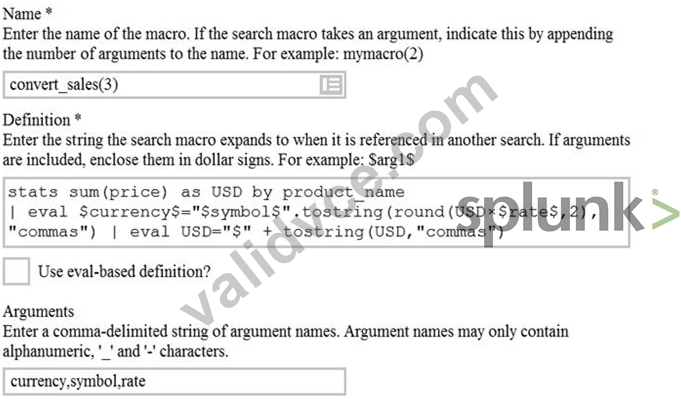
- A. Convert_sales ($euro,$€$,s79$
- B. Convert_sales (euro, €, 79)"
- C. Convert_sales ($euro, $€$,S,79$)
- D. Convert_sales (euro, €, .79)
Answer: D
Explanation:
Reference: https://docs.splunk.com/Documentation/Splunk/8.0.3/Knowledge/Usesearchmacros
NEW QUESTION # 111
A data model consists of which three types of datasets?
- A. Transaction, session ID, metadata.
- B. Constraint, field, value.
- C. Field extraction, regex, delimited.
- D. Events, searches, transactions.
Answer: D
Explanation:
The building block of a data model. Each data model is composed of one or more data model datasets. Each dataset within a data model defines a subset of the dataset represented by the data model as a whole.
Data model datasets have a hierarchical relationship with each other, meaning they have parent-child relationships. Data models can contain multiple dataset hierarchies. There are three types of dataset hierarchies: event, search, and transaction.
https://docs.splunk.com/Splexicon:Datamodeldataset
NEW QUESTION # 112
Which of the following statements describes the use of the Filed Extractor (FX)?
- A. The Field Extractor automatically extracts all field at search time.
- B. Fields extracted using the Field Extractor do not persist and must be defined for each search.
- C. Field extracted using the Extracted persist as knowledge objects.
- D. The Field Extractor uses PERL to extract field from the raw events.
Answer: C
Explanation:
The Field Extractor (FX) is a tool that helps you extract fields from your events using a graphical interface or by manually editing the regular expression2. The FX allows you to create field extractions that persist as knowledge objects, which are entities that you create to add knowledge to your data and make it easier to search and analyze2. Field extractions are methods that extract fields from your raw data using various techniques such as regular expressions, delimiters or key-value pairs2. When you create a field extraction using the FX, you can save it as a knowledge object that applies to your data at search time2. You can also manage and share your field extractions with other users in your organization2. Therefore, option C is correct, while options A, B and D are incorrect because they do not describe the use of the FX.
NEW QUESTION # 113
The Field Extractor (FX) is used to extract a custom field. A report can be created using this custom field. The created report can then be shared with other people in the organization.
If another person in the organization runs the shared report and no results are returned, why might this be?
(Choose all that apply.)
- A. The extraction is private.
- B. The person in the organization running the report does not have access to the index.
- C. Fast mode is enabled.
- D. The dashboard is private.
Answer: A,B
Explanation:
Explanation/Reference:
NEW QUESTION # 114
Which of the following statements describes POST workflow actions?
- A. POST workflow actions can be configured to send POST arguments to the URI location.
- B. By default, POST workflow action are shown in both the event and field menus.
- C. Configuration of a POST workflow action includes choosing a sourcetype.
- D. POST workflow actions can be configured to send email to the URI location.
Answer: B
Explanation:
Reference:
https://docs.splunk.com/Documentation/Splunk/8.0.3/Knowledge/SetupaPOSTworkflowaction
NEW QUESTION # 115
In which of the following scenarios is an event type more effective than a saved search?
- A. When a search should always include the same time range.
- B. When a search needs to be added to other users' dashboards.
- C. When the search string needs to be used in future searches.
- D. When formatting needs to be included with the search string.
Answer: C
Explanation:
Reference:https://answers.splunk.com/answers/4993/eventtype-vs-saved-search.html
An event type is a way to categorize events based on a search string that matches the events2. You can use
event types to simplify your searches by replacing long or complex search strings with short and simple event
type names2. An event type is more effective than a saved search when the search string needs to be used in
future searches because it allows you to reuse the search string without having to remember or type it again2.
Therefore, option C is correct, while options A, B and D are incorrect because they are not scenarios where an
event type is more effective than a saved search.
NEW QUESTION # 116
Which statement is true?
- A. Data model are randomly structured datasets.
- B. Pivot is used for creating reports and dashboards.
- C. Pivot is used for creating datasets.
- D. In most cases, each Splunk user will create their own data model.
Answer: B
Explanation:
Reference:
Pivot is used for creating reports and dashboards. Pivot is a tool that allows you to create reports and dashboards from your data models without writing any SPL commands. Pivot can help you visualize and analyze your data using various options, such as filters, rows, columns, cells, charts, tables, maps, etc. Pivot can also help you accelerate your reports and dashboards by using summary data from your accelerated data models.
Pivot is not used for creating datasets or data models. Datasets are collections of events that represent your data in a structured and hierarchical way. Data models are predefined datasets for various domains, such as network traffic, web activity, authentication, etc. Datasets and data models can be created by using commands such as datamodel or pivot.
NEW QUESTION # 117
Which syntax will find events where the values for the 1 field match the values for the Renewal-MonthYear field?
- A. | where '10yearAnnerversary'='Renewal-MonthYear'
- B. | where '10yearAnnerversary=Renewal-MonthYear
- C. | where 10yearAnnerversary='Renewal-MonthYear'
- D. | where 10yearAnnerversary=Renewal-MonthYear
Answer: D
Explanation:
The correct answer is A. | where 10yearAnnerversary=Renewal-MonthYear.
The where command is used to filter the search results based on an expression that evaluates to true or false.
The where command can compare two fields, two values, or a field and a value. The where command can also use functions, operators, and wildcards to create complex expressions1.
The syntax for the where command is:
| where <expression>
The expression can be a comparison, a calculation, a logical operation, or a combination of these. The expression must evaluate to true or false for each event.
To compare two fields with the where command, you need to use the field names without any quotation marks. For example, if you want to find events where the values for the 10yearAnnerversary field match the values for the Renewal-MonthYear field, you can use the following syntax:
| where 10yearAnnerversary=Renewal-MonthYear
This will return only the events where the two fields have the same value.
The other options are not correct because they use quotation marks around the field names, which will cause the where command to interpret them as string values instead of field names. For example, if you use:
| where '10yearAnnerversary'='Renewal-MonthYear'
This will return no events because there are no events where the string value '10yearAnnerversary' is equal to the string value 'Renewal-MonthYear'.
References:
* where command usage
NEW QUESTION # 118
In the Field Extractor Utility, this button will display events that do not contain extracted fields.
Select your answer.
- A. Selected-Fields
- B. Matches
- C. Non-Matches
- D. Non-Extractions
Answer: C
NEW QUESTION # 119
36. Lookups can be private for a user.
- A. True
- B. False
Answer: A
NEW QUESTION # 120
During the validation step of the Field Extractor workflow:
Select your answer.
- A. You can remove values that aren't a match for the field you want to define
- B. You cannot modify the field extraction
- C. You can validate where the data originated from
Answer: A
NEW QUESTION # 121
Which syntax is used to represent an argument in a macro definition?
- A. "argument"
- B. %argument%
- C. $argument$
- D. 'argument'
Answer: C
Explanation:
The correct answer is D.
A search macro is a way to reuse a piece of SPL code in different searches. A search macro can take arguments, which are variables that can be replaced by different values when the macro is called. A search macro can also contain another search macro within it, which is called a nested macro1.
To represent an argument in a macro definition, you need to use the dollar sign ($) character to enclose the argument name. For example, if you want to create a search macro that takes one argument named "object", you can use the following syntax:
[my_macro(object)] search sourcetype= object
This will create a search macro named my_macro that takes one argument named object. When you call the macro in a search, you need to provide a value for the object argument, such as:
my_macro(web)
This will replace the object argument with the value web and run the following SPL code:
search sourcetype=web
The other options are not correct because they use quotation marks (' or ") or percentage signs (%) to represent arguments, which are not valid syntax for macro arguments. These characters will be interpreted as literal values instead of variables.
References:
* Use search macros in searches
NEW QUESTION # 122
Which of the following searches will return events containing a tag named Privileged?
- A. tag=Priv
- B. tag=Priv*
- C. tag=privileged
- D. tag=priv*
Answer: B
Explanation:
The tag=Priv* search will return events containing a tag named Privileged, as well as any other tag that starts with Priv. The asterisk (*) is a wildcard character that matches zero or more characters. The other searches will not match the exact tag name.
NEW QUESTION # 123
The fields sidebar does not show________. (Select all that apply.)
- A. all extracted fields
- B. interesting fields
- C. selected fields
Answer: A
NEW QUESTION # 124
Which of the following file formats can be extracted using a delimiter field extraction?
- A. PDF
- B. JSON
- C. XML
- D. CSV
Answer: D
Explanation:
A delimiter field extraction is a method of extracting fields from data that uses a character or a string to
separate fields in each event. A delimiter field extraction can be performed by using the Field Extractor (FX)
tool or by editing the props.conf file. A delimiter field extraction can be applied to any file format that uses a
delimiter to separate fields, such as CSV, TSV, PSV, etc. A CSV file is a comma-separated values file that
uses commas as delimiters. Therefore, a CSV file can be extracted using a delimiter field extraction.
NEW QUESTION # 125
Which of the following expressions could be used to create a calculated field called gigabytes?
- A. eval sc_bytes(1024/1024)
- B. megabytes=sc_bytes(1024/1024)
- C. sc_bytas(1024/1024)
- D. | eval negabytes=sc_bytes(1024/1024)
Answer: D
NEW QUESTION # 126
Default fields are not added to every event in SPLUNK at INDEX time.
- A. True
- B. False
Answer: B
NEW QUESTION # 127
What is needed to define a calculated field?
- A. Event type
- B. Regular expression
- C. Data model
- D. Eval expression
Answer: D
Explanation:
A calculated field in Splunk is created using an eval expression, which allows users to perform calculations or transformations on field values during search time.
Reference:
Splunk Docs - Calculated fields
NEW QUESTION # 128
When using the transaction command, what does the argument maxspan do?
- A. Sets the maximum length of all events within a transaction.
- B. Sets the maximum length that any single event can reach to be included in the transaction.
- C. Sets the maximum total time between the earliest and latest events in a transaction.
- D. Sets the maximum total time between events in a transaction.
Answer: A
NEW QUESTION # 129
Which function should you use with the transaction command to set the maximum total time between the
earliest and latest events returned?
- A. maxduration
- B. maxpause
- C. endswith
- D. maxspan
Answer: D
Explanation:
The maxspan function of the transaction command allows you to set the maximum total time between the
earliest and latest events returned. The maxspan function is an argument that can be used with the transaction
command to specify the start and end constraints for the transactions. The maxspan function takes a time
modifier as its value, such as 30s, 5m, 1h, etc. The maxspan function sets the maximum time span between the
first and last events in a transaction. If the time span between the first and last events exceeds the maxspan
value, the transaction will be split into multiple transactions.
NEW QUESTION # 130
Which of the following is true about data model attributes?
- A. They can only be added into a root search dataset.
- B. They cannot be created within the data model.
- C. They cannot be edited if inherited from a parent dataset.
- D. They can be added to a dataset from search time field extractions.
Answer: D
Explanation:
Data model attributes are fields that are added to a dataset from search time field extractions, calculated fields, lookups, or aliases. They can be created within the data model editor or inherited from a parent dataset. They can be edited or removed unless they are required by the data model. They can be added to any type of dataset, not just root search datasets.ReferencesSee About data models, [Define data model attributes], and [Edit data model datasets] in the Splunk Documentation.
NEW QUESTION # 131
......
The SPLK-1002 exam covers a wide range of topics, including data inputs and forwarders, search fundamentals, Splunk indexes, and distributed search. SPLK-1002 exam also tests the candidate's knowledge of creating and managing alerts, using data models, and working with Splunk's REST API. Splunk Core Certified Power User Exam certification is an excellent way for professionals to validate their knowledge and skills in using Splunk Core.
SPLK-1002 Premium PDF & Test Engine Files with 308 Questions & Answers: https://torrentpdf.validvce.com/SPLK-1002-exam-collection.html
