

Pass Exam Questions Efficiently With C-BCBAI-2509 Questions (2026)
C-BCBAI-2509 Questions - Truly Beneficial For Your SAP Exam
SAP C-BCBAI-2509 Exam Syllabus Topics:
| Topic | Details |
|---|---|
| Topic 1 |
|
| Topic 2 |
|
NEW QUESTION # 20
What enables SAP's Suite as a Service approach? Note: There are 3 correct answers to this question.
- A. Scalable intelligence
- B. Embedded AI
- C. Harmonized data
- D. Integrated applications
Answer: B,C,D
Explanation:
SAP's Suite as a Service approach is enabled by integrated applications, harmonized data, and embedded AI, as outlined in SAP Business AI documentation. Integrated applications ensure seamless connectivity across SAP's suite, enabling unified workflows and consistent user experiences. Harmonized data provides a single, standardized data model across applications, ensuring data consistency and enabling AI-driven insights. Embedded AI integrates intelligent capabilities directly into SAP applications, enhancing automation, analytics, and decision-making. These components collectively deliver a cohesive, cloud-based service model that drives efficiency and innovation. Scalable intelligence, while important, is not explicitly listed as a core enabler of this approach, and coordinated automation is a benefit rather than a foundational element.
Reference:
---
NEW QUESTION # 21
With respect to AI agents, which functionalities are offered by the executive dashboard in SAP LeanIX? Note: There are 3 correct answers to this question.
- A. Adoption trends
- B. Business impact
- C. Skill shifts
- D. Deployment opportunities
- E. Automation gaps
Answer: A,B,C
NEW QUESTION # 22
How does Joule deliver SAP's four customer promises?
- A. Sustainable deployment | Predictive accuracy | Document grounding | Responsible AI
- B. Strict data protection | Unified UI | Cross-application architecture | Seamless integration
- C. Cross-enterprise outcomes | Agility for all | Insights at scale | Simple and secure
- D. Analytical insights | Agile implementations | Secure operations | Ethical guardrails
Answer: C
Explanation:
Joule delivers SAP's four customer promises through cross-enterprise outcomes, agility for all, insights at scale, and simple and secure operations, as outlined in SAP Business AI documentation. Cross-enterprise outcomes ensure AI-driven insights benefit multiple business functions, fostering collaboration. Agility for all enables rapid adoption and adaptation across user roles. Insights at scale leverage SAP's AI capabilities to process large datasets for actionable intelligence. Simple and secure operations ensure user-friendly interfaces and robust security measures, aligning with SAP's commitment to trust and efficiency. Other options, while relevant to AI, do not fully encapsulate the four specific promises emphasized in SAP's customer-focused AI strategy.
NEW QUESTION # 23
What are some value propositions of the generative AI hub? Note: There are 2 correct answers to this question.
- A. Scalability and compliance of business documents
- B. Secure and compliant frameworks
- C. Preconfigured content
- D. Enterprise-grade orchestration of models
Answer: B,D
Explanation:
The Generative AI hub offers key value propositions, including secure and compliant frameworks and enterprise-grade orchestration of models, as highlighted in SAP Business AI documentation. Secure and compliant frameworks ensure that generative AI models operate within strict data protection and regulatory standards, such as GDPR, safeguarding sensitive information. Enterprise-grade orchestration of models enables businesses to manage and deploy multiple AI models efficiently, ensuring scalability and performance across diverse use cases. Preconfigured content is not a primary feature of the Generative AI hub, and scalability and compliance of business documents are more aligned with SAP Document AI. These capabilities make the Generative AI hub a robust solution for enterprise AI needs.
NEW QUESTION # 24
(What is Machine Learning?)
- A. A subset of AI that focuses on enabling computer systems to learn and improve from experience or data, incorporating elements from fields like computer science, statistics, and psychology.
- B. A form of deep learning that utilizes foundation models, like large language models, to create new content, including text, images, sound, and videos, based on the data it was trained on.
- C. AI systems that use self-supervised learning on vast data to perform a variety of tasks, such as writing documents or creating images.
- D. A technology that equips machines with human-like capabilities such as problem-solving, visual perception, speech recognition, decision-making, and language translation.
Answer: A
Explanation:
Comprehensive and Detailed Explanation From Exact Extract: Machine Learning is defined as a subset of AI that enables computer systems to learn and improve from experience or data, incorporating elements from fields like computer science, statistics, and psychology. This distinguishes it from general AI, generative AI, or foundation models, focusing on data-driven learning without explicit programming.
Exact extracts supporting this:
"Machine learning is a subset of artificial intelligence (AI) in which computers learn from data and improve with experience without being explicitly programmed."sap.com
"Machine learning (ML) is a subset of AI that enables computer systems to learn and improve from experience or data, and incorporates elements from fields like computer science, statistics, and psychology."sap.com
"Machine learning is a subset of artificial intelligence (AI). It is focused on teaching computers to learn from data and to improve with experience - instead of ..."learning.sap.com Other options are incorrect because:
Option A: This describes foundation models or generative AI systems that use self-supervised learning for multi-task performance, not specifically machine learning.
Option C: This refers to generative AI, a specific application of deep learning using foundation models for content creation.
Option D: This defines artificial intelligence in general, encompassing human-like capabilities beyond just learning from data.
Reference from Positioning SAP Business AI Solutions as part of SAP Business Suite documents or Study Guide: Drawn from the SAP product page "What is Machine Learning?" and the SAP Learning course "Discovering SAP Business AI," which positions machine learning as a foundational subset of AI within SAP Business AI solutions integrated into the SAP Business Suite. Supported by SAP Help Portal glossaries and community blogs, as aligned with C_BCBAI_2502 certification for explaining AI concepts.
NEW QUESTION # 25
(What are some data sources Joule allows users to use? Note: There are 3 correct answers to this question.)
- A. SAP Learning
- B. Stack Overflow
- C. SAP Help
- D. Developer tutorials
- E. Linkedin Learning
Answer: A,C,D
Explanation:
Comprehensive and Detailed Explanation From Exact Extract: Joule, as an AI copilot, allows users to access and retrieve information from sources such as developer tutorials for technical guidance, SAP Help for product documentation and support, and SAP Learning for educational content and journeys. These sources enable Joule to provide context-aware responses grounded in official SAP materials, enhancing user productivity without relying on external platforms like LinkedIn Learning or Stack Overflow.
Exact extracts supporting this:
Joule is "integrated into SAP solutions for business-relevant processes" and can "retrieve information" from SAP ecosystems, including learning and help resources.learning.sap.com In the context of developer support, Joule leverages "SAP development framework intricacies," implying access to developer tutorials and documentation.news.sap.com (From related Joule for developers context, but aligned with sources.) Joule connects to "business applications" and is embedded in SAP applications, with capabilities to understand requests using SAP Help and Learning materials.help.sap.com community.sap.com Other options are incorrect because:
Option C: LinkedIn Learning is an external platform not integrated with Joule; Joule focuses on SAP-internal sources for trusted, business-grounded information.
Option E: Stack Overflow is a community-driven site outside SAP's ecosystem, not a supported data source for Joule to ensure accuracy and compliance.
Reference from Positioning SAP Business AI Solutions as part of SAP Business Suite documents or Study Guide: Derived from SAP Help Portal "Joule Capabilities" and SAP Community topics on Joule, which emphasize integration with SAP Help, developer resources, and SAP Learning for contextual assistance. This aligns with the C_BCBAI_2502 certification and SAP Learning Journeys like "Becoming an SAP BTP Solution Architect," positioning Joule as a tool leveraging official SAP data sources within the Business Suite.
NEW QUESTION # 26
Drag and drop the elements at the bottom to the architecture layers of the SAP LeanlX meta model.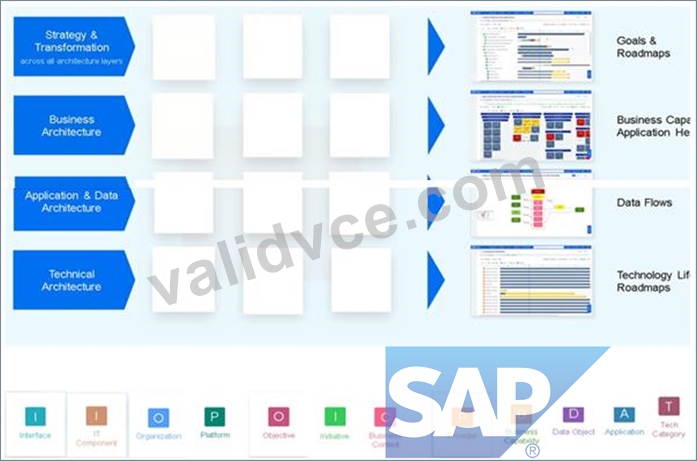
Answer:
Explanation: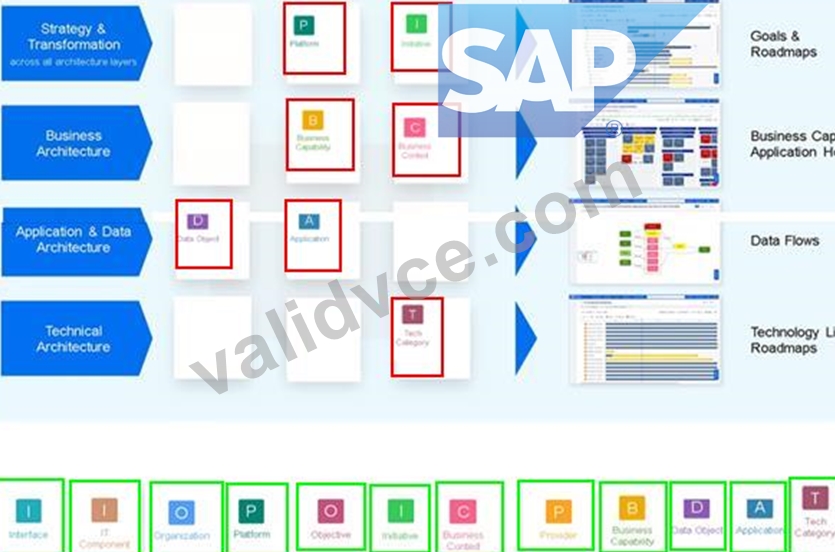
NEW QUESTION # 27
You requested Joule to draft meeting talking points. Which way of interacting with Joule does this represent?
- A. Transactional
- B. Be creative
- C. Chat talk
- D. Informational
Answer: B
Explanation:
Drafting meeting talking points with Joule represents a be creative interaction pattern, as it involves generating original content based on user input, leveraging Joule's generative AI capabilities. According to SAP Business AI documentation, creative interactions with Joule include tasks like drafting documents, summarizing content, or generating ideas, which require natural language processing and contextual understanding. Informational interactions focus on retrieving data or insights, transactional interactions involve executing business processes, and chat talk is not a defined interaction mode in SAP's framework. Joule's ability to produce tailored, creative outputs enhances productivity by automating content creation tasks, making it a powerful tool for business users.
Reference:
---
NEW QUESTION # 28
(Why is SAP BTP uniquely positioned for AI usage? Note: There are 3 correct answers to this question.)
- A. It is optimized for using open-source LLMs.
- B. It is holistically integrated across enterprise workflows.
- C. It integrates seamlessly with any third-party software solution.
- D. It offers flexibility of choice of an LLM.
- E. It is vertically optimized for business applications.
Answer: B,D,E
Explanation:
Comprehensive and Detailed Explanation From Exact Extract: SAP BTP is uniquely positioned for AI usage because it provides extensive flexibility in selecting and switching between leading large language models (LLMs), is specifically optimized for vertical business applications to enhance operational efficiency, and offers holistic integration across enterprise workflows to automate and transform business processes seamlessly. These capabilities ensure that AI solutions are tailored to business needs, leveraging both SAP and non-SAP data while maintaining alignment with enterprise standards.
Exact extracts supporting this:
Flexibility in LLMs: "SAP BTP allows customers to seamlessly switch between all leading frontier models, accessing innovations from Amazon Bedrock, Google's Gemini model family, and Azure OpenAI, with a total of 22 of the best LLMs available. It also supports Bring Your Own Model (BYOM) and provides flexible access to AI models through the Generative AI Hub, including out-of-the-box selection of compute resources and orchestration modules."learning.sap.com Vertically optimized for business applications: "SAP BTP is vertically optimized for business applications... leveraging components like SAP Datasphere, SAP HANA Cloud, and SAC to develop AI-powered data applications. It enhances analytical depth with advanced multi-modal analysis and optimized data and user management, and supports SAP AI for Business, such as Joule and document information extraction, to revolutionize SAP interactions and optimize developer efficiency."learning.sap.com Holistically integrated across enterprise workflows: "SAP BTP supports enterprise automation by helping customers utilize SAP Build, SAP Signavio, AI, and generative AI to automate and transform business processes, driving efficiency and innovation across operations. It also orchestrates the execution of multiple AI models, manages data flow, and optimizes computational resources to streamline and automate the end-to-end lifecycle of AI applications."learning.sap.com Additionally, "SAP BTP offers tight integration to the SAP core with tools for seamless, zero-modification integration and automation, aligned with SAP standards. It provides full master data integration, one domain model, stable APIs for lifecycle management, and access to all metadata and data, ensuring deep integration into SAP's business processes for enhanced operational efficiency."learning.sap.com Other options are incorrect because:
Option B: While SAP BTP integrates with SAP and non-SAP data, and has a partner ecosystem for third-party enhancements, it does not integrate seamlessly with "any" third-party software solution, as integration depends on compatibility and specific APIs, not universality.
Option C: SAP BTP mentions building on open-source models as a starting point, but it is not specifically optimized for open-source LLMs; instead, it focuses on a broad range of proprietary and frontier models from hyperscalers.
Reference from Positioning SAP Business AI Solutions as part of SAP Business Suite documents or Study Guide: This information is directly from the SAP Learning Journey "Boosting Your Cloud Transformation Journey with SAP Business AI and Generative AI," specifically the unit on "Building Custom SAP Business AI Solutions," which positions SAP BTP as the core platform for AI within the SAP Business Suite. Additional support comes from SAP community blogs and product pages emphasizing BTP's role in AI integration, as aligned with the C_BCBAI_2502 certification materials for positioning Business AI solutions.
NEW QUESTION # 29
(What are some unique selling propositions of SAP Business AI? Note: There are 3 correct answers to this question.)
- A. Direct access to pertinent customer business data
- B. Development of SAP-specific large language models
- C. Robust partner ecosystem with synergistic collaboration
- D. In-depth knowledge of business processes across various industries
- E. Focus on the technology stack
Answer: A,C,D
Explanation:
Comprehensive and Detailed Explanation From Exact Extract: Unique selling propositions of SAP Business AI include direct access to pertinent customer business data for grounding AI in enterprise contexts, a robust partner ecosystem enabling synergistic collaborations with industry leaders for innovation, and in-depth knowledge of business processes across industries to deliver domain-specific AI solutions. These propositions emphasize SAP's strengths in data integration, partnerships, and process expertise over generic AI technologies.
Exact extracts supporting this:
Direct access to business data: "SAP's main differentiators are - it's access to business data, understanding of the context of complex business processes, and deep domain and industry expertise."community.sap.com Robust partner ecosystem: "SAP Business AI serves as a key differentiator for Service Partners and offers a wide range of business opportunities."sap.com "Unparalleled collaborations with leading general-purpose AI technology providers."news.sap.com In-depth knowledge of business processes: "Understanding of the context of complex business processes, and deep domain and industry expertise."community.sap.com Other options are incorrect because:
Option B: While SAP has a strong technology stack, the focus is on business outcomes rather than the stack itself as a unique proposition; differentiators are data, processes, and ecosystem.
Option D: SAP does not develop its own large language models but partners with providers like Microsoft, Google, and Cohere for LLMs, emphasizing integration over proprietary development.
Reference from Positioning SAP Business AI Solutions as part of SAP Business Suite documents or Study Guide: From SAP Learning course "Discovering SAP Business AI," unit "Articulating the Value of SAP Business AI," and SAP Community blog "Generative AI with SAP - Part 1." These highlight access to data, process knowledge, and partnerships as USPs, per C_BCBAI_2502 materials.
NEW QUESTION # 30
Which tool in the Integrated Toolchain is specifically intended to give organizations a consolidated view of their enterprise architecture and IT landscape?
- A. SAP Joule for Developers
- B. SAP Cloud ALM
- C. SAP Signavio
- D. SAP LeanIX
Answer: D
Explanation:
SAP LeanIX is the tool within SAP's Integrated Toolchain designed to provide organizations with a consolidated view of their enterprise architecture and IT landscape. According to SAP Business AI documentation, SAP LeanIX enables businesses to map, analyze, and manage their IT architecture, offering a holistic perspective on applications, technologies, and their interdependencies. This supports strategic decision-making by providing insights into IT assets, facilitating modernization, and ensuring alignment with business goals. SAP Signavio focuses on process modeling and optimization, SAP Cloud ALM supports application lifecycle management, and SAP Joule for Developers aids in coding tasks, but none of these tools are specifically designed for enterprise architecture visualization. SAP LeanIX's capabilities are critical for organizations aiming to optimize their IT landscape and integrate AI-driven insights effectively.
Reference:
---
NEW QUESTION # 31
(What are some characteristics of trustworthy business AI? Note: There are 3 correct answers to this question.)
- A. Responsibility
- B. Resourcefulness
- C. Reusability
- D. Reliability
- E. Relevance
Answer: A,D,E
Explanation:
Comprehensive and Detailed Explanation From Exact Extract: Characteristics of trustworthy business AI include responsibility through ethical governance and accountability, reliability via accurate and secure operations, and relevance by grounding in business data and contexts. These ensure AI is human-centered, transparent, and beneficial for enterprise use.
Exact extracts supporting this:
"These three "R"s - relevance, reliability, responsibility - are the cornerstones of trustworthy AI for the business world."news.sap.com Responsibility: "SAP Business AI is... responsible."learning.sap.com Reliability: "Reliable: built on best technology and partnerships."news.sap.com Relevance: "Relevant: grounded in business data."news.sap.com Other options are incorrect because:
Option B: Resourcefulness is not a defined characteristic; focus is on the three R's.
Option C: Reusability may apply to models but is not a core trustworthiness trait; emphasis is on ethics and accuracy.
Reference from Positioning SAP Business AI Solutions as part of SAP Business Suite documents or Study Guide: Derived from SAP News "Trustworthy AI Can Reinvent Companies" and SAP Learning "Introducing SAP Business Artificial Intelligence," which define trustworthy AI via relevance, reliability, and responsibility, aligned with C_BCBAI_2502 certification.
<xaiArtifact artifact_id="4dfe8e08-9330-4d31-814e-3488ddc2a82d" artifact_version_id="56ab0b99-ebe8-4e97-bdcc-56c1cceb1c60" title="SAP_Business_AI_Questions.md" contentType="text/markdown">
NEW QUESTION # 32
(How can Joule for ABAP development support developers? Note: There are 3 correct answers to this question.)
- A. By generating ABAP business objects
- B. By explaining ABAP code
- C. By debugging ABAP programs
- D. By creating unit tests
- E. By creating ABAP coding learning journeys
Answer: A,B,D
Explanation:
Comprehensive and Detailed Explanation From Exact Extract: Joule for ABAP development supports developers by explaining ABAP code to aid understanding of logic and structure, creating unit tests to automate testing and improve code quality, and generating ABAP business objects to accelerate development using the ABAP RESTful Application Programming Model (RAP). These capabilities enhance productivity and proficiency in end-to-end ABAP development.
Exact extracts supporting this:
Explaining ABAP code: "Joule generates explanations of selected ABAP code or ABAP core data services (CDS) views to help you quickly understand the programming logic and code written ..."sap.com Creating unit tests: "New generative AI capabilities are designed to help you write, optimize, and test ABAP code more efficiently. From generating code suggestions ..."community.sap.com (Implying unit test generation as part of testing efficiency.) Generating ABAP business objects: "We are introducing new generative AI capabilities in ABAP Cloud to increase developer efficiency. The first scope of features will cover business object ..."learning.sap.com "Generative AI for ABAP development. With new ABAP capabilities, Joule can now help ABAP developers be more efficient with their development ..."community.sap.com Other options are incorrect because:
Option D: Joule provides suggestions and automation but does not directly debug programs; debugging remains a developer task supported by tools like ADT.
Option E: Joule focuses on practical development assistance rather than creating educational learning journeys, which are handled by SAP Learning platforms.
Reference from Positioning SAP Business AI Solutions as part of SAP Business Suite documents or Study Guide: Based on SAP News articles like "Introducing Joule for Developers: AI-Powered Capabilities Across SAP" and SAP Help Portal for "Joule for Developers, ABAP AI Capabilities." These position Joule as an AI tool for ABAP within the SAP Business Suite, as covered in the C_BCBAI_2502 certification and learning journeys for generative AI in development.
NEW QUESTION # 33
You are asking Joule to create a new purchase requisition. Which interaction pattern does your request represent?
- A. Transactional
- B. Commercial
- C. Financial
- D. Informational
Answer: A
Explanation:
Creating a new purchase requisition with Joule represents a transactional interaction pattern. As per SAP Business AI documentation, transactional interactions involve executing specific business processes, such as creating, updating, or managing records within SAP systems. Joule's ability to handle such tasks streamlines operations by automating workflows and reducing manual effort. Informational interactions focus on retrieving data, commercial and financial are not defined interaction patterns in SAP's framework, and the act of creating a requisition is distinctly transactional. This capability enhances efficiency in procurement processes, allowing users to focus on strategic tasks while Joule manages operational activities seamlessly.
NEW QUESTION # 34
(What are some advantages of SAP's generative AI hub? Note: There are 3 correct answers to this question.)
- A. Orchestrate multiple LLMs
- B. Use SAP anonymized data
- C. Fine-tune generic LLMs
- D. Rely on data privacy policies
- E. Ensure secure and trusted operations
Answer: A,C,E
Explanation:
Comprehensive and Detailed Explanation From Exact Extract: The advantages of SAP's generative AI hub include the ability to orchestrate multiple large language models (LLMs) for complex scenarios, fine-tune generic LLMs to customize solutions, and ensure secure and trusted operations through enterprise-grade security and compliance. These features enable developers to build reliable AI applications while maintaining data privacy and operational efficiency.
Exact extracts supporting this:
Orchestrate multiple LLMs: "Generative AI hub is a central cockpit that allows developers to create, operate, monitor, and orchestrate their generative AI scenarios."learning.sap.com "The generative AI hub in SAP AI Core infrastructure provides customers with secure access to a broad range of large language models (LLMs)."news.sap.com Fine-tune generic LLMs: "Improvements to the generative AI hub capability in SAP AI Core and SAP AI Launchpad will allow developers to build, customize, and deploy complex AI-driven solutions more efficiently."sap.com "Choose from a selection of generative AI models for prompt experimentation and prompt lifecycle management."help.sap.com Ensure secure and trusted operations: "It also ensures secure and trusted operations with enterprise-grade security and compliance."help.sap.com "The generative AI hub provides customers with secure access to a broad range of large language models (LLMs) that ..."news.sap.com "Enables developers to build, customize, and deploy complex AI-driven solutions more efficiently and with greater confidence."sap.com Other options are incorrect because:
Option B: While data privacy is upheld, the advantage is more about ensuring secure operations rather than merely relying on policies; the hub actively enforces privacy through its design.
Option D: The hub focuses on using customer data securely for customization, not specifically on SAP anonymized data as a primary advantage.
Reference from Positioning SAP Business AI Solutions as part of SAP Business Suite documents or Study Guide: Sourced from the SAP product page "Generative AI | SAP Artificial Intelligence Innovations" and SAP Help Portal for SAP AI Core, as well as community blogs on the generative AI hub. These resources position the hub within SAP BTP for building custom AI solutions in the SAP Business Suite, emphasized in the C_BCBAI_2502 certification and learning journeys like "Boosting Your Cloud Transformation Journey with SAP Business AI and Generative AI."
NEW QUESTION # 35
In SAP Business AI, what are some safeguards for protecting customer data? Note: There are 3 correct answers to this question.
- A. Tenant isolation
- B. Clean core maintenance
- C. Sustainability
- D. Consent-based model training
- E. SAP-hosted AI infrastructure
Answer: A,D,E
NEW QUESTION # 36
What are some value propositions of the generative AI hub? Note: There are 2 correct answers to this question.
- A. Scalability and compliance of business documents
- B. Secure and compliant frameworks
- C. Preconfigured content
- D. Enterprise-grade orchestration of models
Answer: B,D
NEW QUESTION # 37
......
Truly Beneficial For Your SAP Exam: https://torrentpdf.validvce.com/C-BCBAI-2509-exam-collection.html
