

Latest SAP C-AIG-2412 First Attempt, Exam real Dumps Updated [Dec-2025]
Get the superior quality C-AIG-2412 Dumps Questions from ValidVCE. Nobody can stop you from getting to your dreams now. Your bright future is just a click away!
NEW QUESTION # 35
What is a part of LLM context optimization?
- A. Providing the model with domain-specific knowledge needed to solve a problem
- B. Adjusting the model's output format and style
- C. Reducing the model's size to improve efficiency
- D. Enhancing the computational speed of the model
Answer: A
Explanation:
LLM context optimization involves tailoring a Large Language Model's (LLM) input context to enhance its performance on specific tasks, particularly by incorporating domain-specific knowledge.
1. Understanding LLM Context Optimization:
* Definition:Context optimization refers to the process of adjusting the input provided to an LLM to ensure it includes relevant information, thereby enabling the model to generate more accurate and contextually appropriate outputs.
* Domain-Specific Knowledge Integration:By embedding domain-specific information into the model's context, the LLM can better understand and address specialized queries, leading to improved problem- solving capabilities.
2. Importance of Domain-Specific Knowledge:
* Enhanced Relevance:Providing domain-specific context ensures that the model'sresponses are pertinent to the particular field or subject matter, increasing the utility of the generated content.
* Improved Accuracy:With access to specialized knowledge, the LLLM is less likely to produce generic or incorrect answers, thereby enhancing the overall quality of its outputs.
3. Methods of Context Optimization:
* Prompt Engineering:Crafting prompts that include necessary domain-specific information to guide the model towards generating desired responses.
* Retrieval-Augmented Generation (RAG):Incorporating external data sources into the model's context to provide up-to-date and relevant information pertinent to the domain.
NEW QUESTION # 36
Which of the following executables in generative Al hub works with Anthropic models?
- A. Azure OpenAl Service
- B. GCP Vertex Al
- C. AWS Bedrock
- D. SAP AI Core
Answer: C
NEW QUESTION # 37
Which of the following is unique about SAP's approach to Al?
- A. Offering Al capabilities in their future products as of 2025.
- B. Utilizing Al mainly for marketing purposes.
- C. Focusing Al solely on customer support services.
- D. SAP's deep integration of Al with business processes and analytics.
Answer: D
NEW QUESTION # 38
What can be done once the training of a machine learning model has been completed in SAP AI Core? Note: There are 2 correct answers to this question.
- A. The model can be deployed in SAP HAN
- B. The model can be deployed for inferencing.
- C. The model can be registered in the hyperscaler object store.
- D. The model's accuracy can be optimized directly in SAP HANA.
Answer: B,C
NEW QUESTION # 39
Which of the following steps must be performed to deploy LLMs in the generative Al hub?
- A. Provision SAP AI
* Core Create a configuration
* Run the booster - B. Check for foundation model scenario
* Create a deployment
* Configuring entitlements - C. Provision SAP AI Core
* Check for foundation model scenario
* Create a configuration
* Create a deployment - D. Run the booster
* Create service keys
* Select the executable ID
Answer: C
NEW QUESTION # 40
What is a significant risk associated with using LLMs?
- A. Complete elimination of human oversight in content creation
- B. Potential biases in generated content
- C. Inability to generate text in multiple languages
- D. Unlimited processing power usage without cost control
Answer: B
Explanation:
A significant risk of using LLMs is the potential for biases in generated content, stemming from biases present in their training data. Option A is incorrect because LLMs do not inherently eliminate human oversight; oversight is often maintained, especially in enterprise settings like SAP's. Option B is false as LLMs can generate text in multiple languages, as seen with models like GPT-4. Option D, while a concern in terms of resource management, is not the most significant risk compared to bias, and cost control can be implemented. Option C is correct because biased outputs can lead to unfair decisions or misinformation, a risk SAP mitigates through its AI Ethics framework, which includes principles like avoiding bias and discrimination, ensuring responsible AI deployment.
NEW QUESTION # 41
What are some metrics to evaluate the effectiveness of a Retrieval Augmented Generation system?
Note: There are 2 correct answers to this question.
- A. Relevance
- B. Speed
- C. Carbon footprint
- D. Faithfulness
Answer: A,D
NEW QUESTION # 42
Match the components of a Retrieval Augmented Generation architecture to the diagram.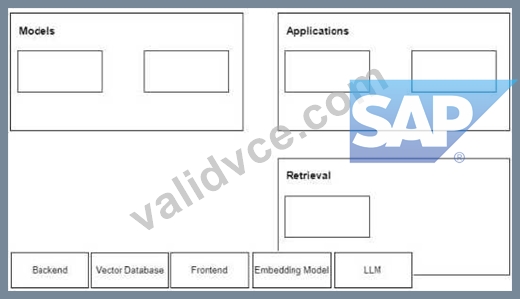
Answer:
Explanation: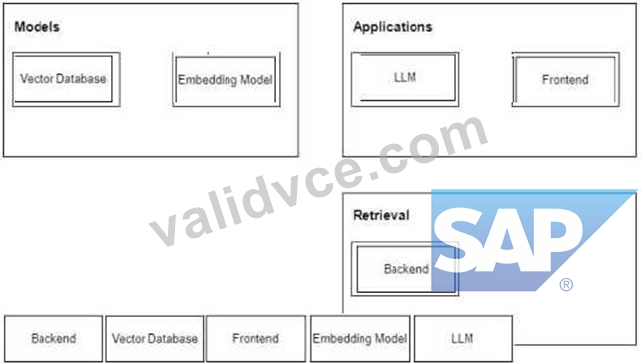
NEW QUESTION # 43
What are some advantages of using agents in training models? Note: There are 2 correct answers to this question.
- A. To improve the quality of results
- B. To streamline LLM workflows
- C. To eliminate the need for human oversight
- D. To guarantee accurate decision making in complex scenarios
Answer: A,B
Explanation:
Incorporating agents into the training and deployment of Large Language Models (LLMs) offers notable advantages:
1. Improving the Quality of Results:
* Specialized Task Handling:Agents can be designed to manage specific tasks or subtasks within a larger process, ensuring that each component is handled with expertise, thereby enhancing the overall quality of the output.
* Error Reduction:By delegating particular functions to specialized agents, the likelihood of errors decreases, leading to more accurate and reliable results.
2. Streamlining LLM Workflows:
* Process Automation:Agents can automate repetitive or time-consuming tasks within the LLM workflow, increasing efficiency and allowing human resources to focus on more complex aspects of model development and deployment.
* Workflow Management:Agents facilitate the coordination of various stages in the LLM pipeline, ensuring seamless transitions between tasks and improving overall workflow efficiency.
3. Enhancing Model Performance:
* Adaptive Learning:Agents can monitor model performance and implement adjustments in real-time, promoting continuous improvement and adaptability to new data or requirements.
* Resource Optimization:By managing specific tasks, agents help in optimizing computational resources, ensuring that the LLM operates efficiently without unnecessary expenditure of processing power.
NEW QUESTION # 44
What are some examples of generative Al technologies? Note: There are 2 correct answers to this question.
- A. Robotic process automation
- B. Al models that generate new content based on training data
- C. Foundation models
- D. Rule-based algorithms
Answer: B,C
Explanation:
Generative AI encompasses technologies that create new content by learning from existing data.
1. AI Models That Generate New Content Based on Training Data:
* Definition:These models analyze large datasets to produce original outputs, such as text, images, or music, that resemble the patterns found in the training data.
* Examples:Models like GPT-4 generate human-like text, while DALL E creates images from textual descriptions.
2. Foundation Models:
* Definition:Foundation models are large-scale AI models trained on extensive data across various domains. They serve as a base for fine-tuning on specific tasks, enabling versatility in applications.
* Examples:Models such as BERT and GPT-3 are foundation models that can be adapted for tasks like translation, summarization, or content generation.
NEW QUESTION # 45
Which of the following sequence of steps does SAP recommend you use to solve a business problem using generative Al hub?
- A. Create a basic prompt in SAP AI Launchpad
*Enhance the prompts
*Create a baseline evaluation method for the simple prompt
*Evaluate various models for the problem using generative-ai-hub-sdk
*Scale the solution using generative-ai-hub-sdk - B. Create a basic prompt in SAP AI Launchpad
*Evaluate various models for the problem using generative-ai-hub-sdk
*Scale the solution using generative-ai-hub-sdk
*Create a baseline evaluation method for the simple prompt
*Enhance the prompts. - C. Create a basic prompt in SAP AI Launchpad
*Scale the solution using generative-ai-hub-sdk
*Create a baseline evaluation method for the simple prompt
*Enhance the prompts
*Evaluate various models for the problem using generative-ai-hub-sdk
Answer: A
Explanation:
SAP recommends the following sequence of steps to effectively solve a business problem using the Generative AI Hub:
1. Create a Basic Prompt in SAP AI Launchpad:
* Initiation:Begin by formulating a simple prompt within SAP AI Launchpad to address the business problem. This serves as the foundation for subsequent refinements.
2. Enhance the Prompts:
* Refinement:Iteratively improve the initial prompt to better capture the nuances of the business problem, ensuring clarity and relevance.
3. Create a Baseline Evaluation Method for the Simple Prompt:
* Establish Metrics:Develop an evaluation framework to assess the performance of the prompt, setting a baseline for comparison as enhancements are made.
4. Evaluate Various Models for the Problem Using generative-ai-hub-sdk:
* Model Assessment:Utilize the generative-ai-hub-sdk to test different large language models (LLMs) against the refined prompt, identifying the model that delivers optimal results.
5. Scale the Solution Using generative-ai-hub-sdk:
* Deployment:Once the optimal model and prompt are determined, employ the generative-ai-hub-sdk to scale the solution, integrating it into the business workflow for widespread application.
Conclusion:
Following this structured approach ensures a methodical development and deployment of AI-driven solutions, enhancing their effectiveness in addressing specific business challenges.
NEW QUESTION # 46
What defines SAP's approach to LLMs?
- A. Ensuring ethical AI practices and seamless business integration
- B. Limiting LLM usage to non-business applications only
- C. Focusing solely on reducing the computational cost of training LLMs
- D. Prioritizing the development of proprietary LLMs with no integration to existing systems
Answer: A
Explanation:
SAP's approach to Large Language Models (LLMs) is centered on integrating these powerful AI tools into its enterprise ecosystem while adhering to ethical standards. Unlike option A, SAP does not focus solely on proprietary LLMs without integration; instead, it leverages both proprietary and third-party models (e.g., via partnerships with providers like Azure OpenAI) to enhance business applications. Option B is incorrect because reducing computational cost is not the sole focus-SAP prioritizes value delivery through integration with business processes. Option D is also inaccurate, as SAP explicitly targets business applications rather than limiting LLMs to non-business use. Option C is correct because SAP emphasizes ethical AI practices (e.
g., through its AI Ethics Policy) and seamless integration with tools like SAP S/4HANA and SAP SuccessFactors, ensuring LLMs enhance enterprise workflows responsibly and effectively.
NEW QUESTION # 47
What can be done once the training of a machine learning model has been completed in SAP AICore? Note:
There are 2 correct answers to this question.
- A. The model can be deployed in SAP HANA.
- B. The model can be deployed for inferencing.
- C. The model can be registered in the hyperscaler object store.
- D. The model's accuracy can be optimized directly in SAP HANA.
Answer: B,C
Explanation:
Once the training of a machine learning model has been completed in SAP AI Core, several post-training actions can be undertaken to operationalize and manage the model effectively.
1. Deploying the Model for Inferencing:
* Deployment Process:After training, the model can be deployed as a service to handle inference requests. This involves setting up a model server that exposes an endpoint for applications to send data and receive predictions.
* Integration:The deployed model can be integrated into business applications, enabling real-time decision-making based on the model's predictions.
NEW QUESTION # 48
Which statement best describes the Chain-of-Thought (COT) prompting technique?
- A. Connecting related concepts by having the LLM generate chains of ideas.
- B. Writing a series of connected prompts creating a chain of related information.
- C. Concatenating multiple related prompts to form a chain, guiding the model through sequential reasoning steps.
- D. Linking multiple Al models in sequence, where each model's output becomes the input for the next model in the chain.
Answer: C
Explanation:
Chain-of-Thought (CoT) prompting is a technique that involves concatenating multiple related prompts to guide a language model through a series of reasoning steps, leading to a final conclusion.
1. Structure of CoT Prompting:
* Sequential Reasoning:By breaking down a complex problem into a sequence of intermediate prompts, the model addresses each step methodically, enhancing its problem-solving capabilities.
* Logical Progression:Each prompt builds upon the previous one, ensuring a coherent flow of information that mirrors human logical reasoning.
2. Advantages of CoT Prompting:
* Enhanced Comprehension:This structured approach helps the model understand and process intricate tasks by focusing on one aspect at a time.
* Improved Accuracy:By guiding the model through detailed reasoning steps, CoT prompting reduces the likelihood of errors in the final output.
NEW QUESTION # 49
Why would a user include formatting instructions within a prompt?
- A. To ensure the model's response follows a desired structure or style
- B. To force the model to separate relevant and irrelevant output
- C. To redirect the output to another software program
- D. To increase the faithfulness of the output
Answer: A
NEW QUESTION # 50
What are some examples of generative Al technologies? Note: There are 2 correct answers to this question.
- A. Robotic process automation
- B. Al models that generate new content based on training data
- C. Foundation models
- D. Rule-based algorithms
Answer: B,C
NEW QUESTION # 51
Which of the following techniques uses a prompt to generate or complete subsequent prompts (streamlining the prompt development process), and to effectively guide Al model responses?
- A. Meta prompting
- B. One-shot prompting
- C. Few-shot prompting
- D. Chain-of-thought prompting
Answer: A
Explanation:
Meta prompting is a technique in prompt engineering where a prompt is designed to generate or refine subsequent prompts.
1. Definition and Purpose:
* Streamlining Prompt Development:Meta prompting automates the creation of effective prompts by utilizing AI to generate or enhance them, thereby streamlining the prompt development process.
* Guiding AI Model Responses:By generating refined prompts, meta prompting effectively guides AI models to produce more accurate and contextually relevant responses.
2. Application in SAP's Generative AI Hub:
* Prompt Engineering Tools:SAP's Generative AI Hub provides tools that support advanced prompt engineering techniques, including meta prompting, to enhance AI model interactions.
NEW QUESTION # 52
What are some benefits of the SAP AI Launchpad? Note: There are 2 correct answers to this question.
- A. Direct deployment of Al models to SAP HAN
- B. Integration with non-SAP platforms like Azure and AWS.
- C. Centralized Al lifecycle management for all Al scenarios.
- D. Simplified model retraining and performance improvement.
Answer: C,D
NEW QUESTION # 53
What are the applications of generative Al that go beyond traditional chatbot applications? Note: There are 2 correct answers to this question.
- A. To interpret human instructions and control software systems always producing output for human consumption.
- B. To produce outputs based on software input.
- C. To interpret human instructions and control software systems without necessarily producing output for human consumption.
- D. To follow a specific schema - human input, Al processing, and output for human consumption.
Answer: A,C
Explanation:
* C. To interpret human instructions and control software systems without necessarily producing output for human consumption.This is a key area where generative AI is breaking new ground. Think of it as AI acting as a "middleman" between you and software. Here are some examples:
* Automating complex tasks:You could tell the AI to "optimize this database for performance" or
"find and fix security vulnerabilities in this code." The AI would then interact with the software systems to carry out these instructions, without needing to show you every step or result.
* Controlling robots or IoT devices:Imagine instructing an AI to "adjust the lighting in the meeting room" or "have the robot retrieve the package from the warehouse." The AI translates your instructions into actions for those systems.
* Managing cloud resources:AI could dynamically allocate cloud resources based on your needs, scaling them up or down without your direct intervention.
* D. To interpret human instructions and control software systems always producing output for human consumption.This is more in line with traditional chatbot interactions, but with a broader scope. It's about AI generating outputs that are directly useful or informative for humans. Examples include:
* Creating realistic images or videos:Based on your description, the AI could generate a photorealistic image of a new product design or a short video clip for a marketing campaign.
* Writing different kinds of creative text formats:AI can generate stories, poems,articles, summaries, and even code, all tailored to your specifications.
* Providing personalized recommendations:AI can analyze your preferences and provide recommendations for products, services, or information.
Why the other options are incorrect:
* A. To produce outputs based on software input.This is a general capability of AI, not something specific to generative AI or beyond chatbots. Many AI systems analyze software input (like sensor data or log files) to produce outputs.
* B. To follow a specific schema - human input, AI processing, and output for human consumption.
This describes the basic interaction pattern of many AI systems, including chatbots. It's not something that specifically differentiates generative AI or goes beyond typical chatbot applications.
NEW QUESTION # 54
What are some use cases for fine-tuning of a model? Note: There are 2 correct answers to this question.
- A. To quickly create iterations on a new use case
- B. To customize outputs for specific types of inputs
- C. To sanitize model outputs
- D. To introduce new knowledge to a model in a resource-efficient way
Answer: B,D
NEW QUESTION # 55
What capabilities does the Exploration and Development feature of the generative Al hub provide? Note: There are 2 correct answers to this question.
- A. Prompt editor and management
- B. Develop and debug ABAP code
- C. Al playground and chat
- D. Automatic model selection
Answer: A,C
NEW QUESTION # 56
What does the Prompt Management feature of the SAP AI launchpad allow users to do?
- A. Interact with models through a conversational interface
- B. Provide personalized user interactions
- C. Create and edit prompts
- D. Access and manage saved prompts and their versions
Answer: C,D
Explanation:
The Prompt Management feature within SAP AI Launchpad's Generative AI Hub offers users comprehensive tools for handling prompts throughout their lifecycle:
1. Create and Edit Prompts:
* Prompt Editor:Users can utilize the Prompt Editor to craft and modify prompts, facilitating effective prompt engineering and experimentation.
2. Access and Manage Saved Prompts and Their Versions:
* Prompt Lifecycle Management:The platform provides capabilities to manage the lifecycle of prompts, including accessing saved prompts, tracking their versions, and organizing them for efficient reuse and iteration.
Conclusion:
SAP AI Launchpad's Prompt Management feature empowers users to create, edit, and manage prompts effectively, supporting robust prompt engineering and lifecycle management within the Generative AI Hub.
NEW QUESTION # 57
What is the primary function of the embedding model in a RAG system?
- A. To store vector representations of documents and search for relevant passages
- B. To generate responses based on retrieved documents and user queries
- C. To evaluate the faithfulness and relevance of generated Answers
- D. To encode queries and documents into vector representations for comparison
Answer: D
Explanation:
In a Retrieval-Augmented Generation (RAG) system, the embedding model plays a crucial role in encoding textual data into vector representations, facilitating efficient retrieval and comparison.
1. Function of the Embedding Model:
* Vector Encoding:The embedding model transforms both user queries and documents into high- dimensional vector representations. This numerical encoding captures the semantic meaning of the text, enabling the system to assess similarities between different pieces of text effectively.
* Facilitating Retrieval:By encoding text into vectors, the system can perform efficient similarity searches within a vector database, identifying documents or passages that are most relevant to the user's query.
2. Importance in RAG Systems:
* Semantic Matching:The vector representations allow the system to match user queries with relevant documents based on semantic content rather than mere keyword overlap, enhancing the relevance of retrieved information.
* Efficiency:Vector-based retrieval is computationally efficient, enabling rapid identificationof pertinent information from large datasets, which is essential for real-time applications.
3. Application in SAP's Generative AI Hub:
* Integration with HANA Vector Search:SAP's Generative AI Hub integrates embedding models with HANA's vector search capabilities, allowing for efficient storage and retrieval of vector embeddings.
This integration supports the development of RAG systems that can effectively utilize SAP's data assets.
* Generative AI Hub SDK:SAP provides an SDK that facilitates the implementation of embedding models within RAG systems, enabling developers to encode queries and documents into vector representations seamlessly.
NEW QUESTION # 58
What are the applications of generative Al that go beyond traditional chatbot applications?
Note: There are 2 correct answers to this question.
- A. To interpret human instructions and control software systems always producing output for human consumption.
- B. To produce outputs based on software input.
- C. To interpret human instructions and control software systems without necessarily producing output for human consumption.
- D. To follow a specific schema - human input, Al processing, and output for human consumption.
Answer: A,C
NEW QUESTION # 59
......
Guaranteed Success with Valid SAP C-AIG-2412 Dumps: https://torrentpdf.validvce.com/C-AIG-2412-exam-collection.html
