

Salesforce Salesforce-MuleSoft-Developer-I Real Exam Questions Guaranteed Updated Dump from ValidVCE
Verified Pass Salesforce-MuleSoft-Developer-I Exam in First Attempt Guaranteed
NEW QUESTION # 23
Refer to the exhibit.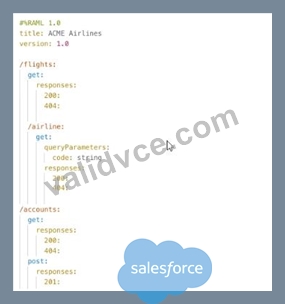
How many private flows does APIKIT generate from the RAML specification?
- A. 0
- B. 1
- C. 2
- D. 3
Answer: C
NEW QUESTION # 24
Refer to the exhibits.
A web client sends sale data ina POST request to the Mule application. The Transform Message component then enrich the payload by prepending a vendor name to the sale data.
What is written to the sales.csv file when the flow executes?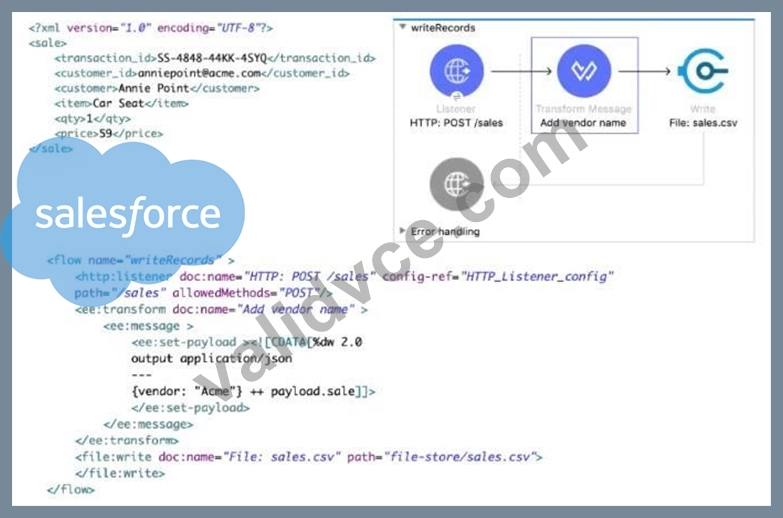
- A. The enriched payload in CSV format
- B. The enriched payload in JSON format
- C. The enriched payload in XML format
- D. An error message
Answer: B
Explanation:
Reference:https://developer.mulesoft.com/tutorials-and-howtos/quick-start/how-to-create-your-first-munit- test-in-anypoint-studio
NEW QUESTION # 25
How are query parameters dynamically passed to an outbound REST request using an HTTP Request operation?
- A. In the Mule event's payload
- B. As URI parameters in the HTTP Request operation
- C. As flow variables
- D. As query parameters in the HTTP Request operation
Answer: D
Explanation:
In General > Request > Query Parameters, click the plus icon (+) to add a parameter to a request. Type a name and value for the parameter or use a DataWeave expression to define the name and value.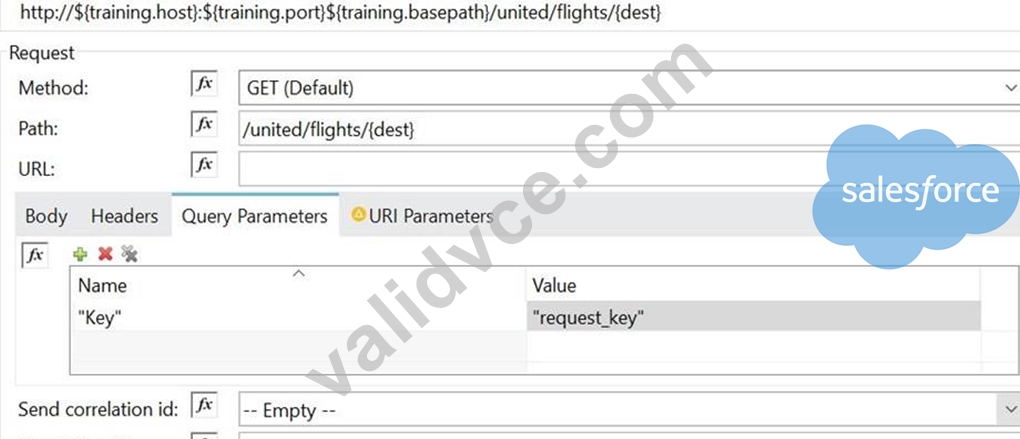
NEW QUESTION # 26
Refer to exhibits.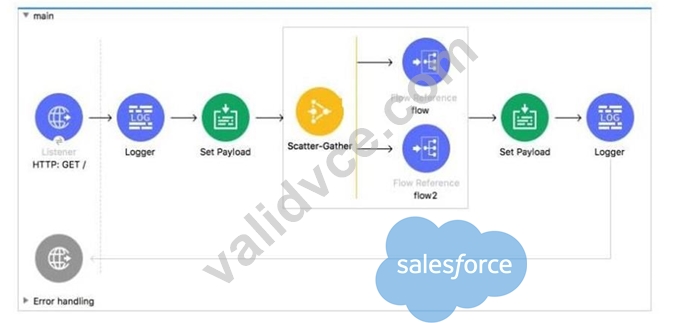
In the execution of the Scatter-Gather , the flow route completes after 10 seconds and the flow2 route completes in 40 seconds. How many seconds does it take for the Scatter-Gather to complete?
- A. 0
- B. 1
- C. 2
- D. 3
Answer: D
Explanation:
Scatter-Gather sends the event to each routes concurrently. Hence both route in this example will start in parallel. So total time to complete processing is 40 seconds The Scatter-Gather component is a routing event processor thatprocesses a Mule event through different parallel processing routes that contain different event processors. Each route receives a reference to the Mule event and executes a sequence of one or more event processors. Each of these routes uses a separate thread to execute the event processors, and the resulting Mule event can be either the same Mule event without modifications or a new Mule event with its own payload, attributes, and variables. The Scatter-Gather component then combines the Mule events returned by each processing route into a new Mule event that is passed to the next event processor only after every route completes successfully.
The Scatter-Gather component executes each route in parallel, not sequentially. Parallel execution of routes can greatly increase the efficiency of your Mule application and may provide more information than sequential processing.
Mule Ref Doc : https://docs.mulesoft.com/mule-runtime/4.3/scatter-gather-concept
NEW QUESTION # 27
What of the below is not a feature of API Notebooks?
- A. API documentation
- B. Perform authenticated live calls on a real server
- C. Creates a mock service for an API
- D. Creates a client for an API
Answer: C
Explanation:
Correct answer is Creates a mock service for an API
API Notebook is an open source, shareable web application for API documentation, interactive API tutorial and example generatation, and a client for your API endpoints. Using API Notebook, you can make requests and quickly transform the responses into readable format. However it cannot be used to mock service for an API.
MuleSoft Doc Ref : https://docs.mulesoft.com/api-manager/1.x/api-notebook-concept
NEW QUESTION # 28
Refer to the exhibits.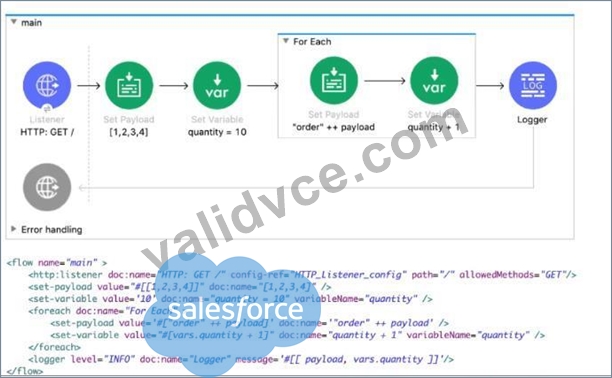
What payload and quantity are togged at the end of the main flow?
- A. [[1,2,3,4], 10]
- B. [orderlorder2order3order4, 14]
- C. [[1,2,3,4],14]
- D. [[order1, order2, order3, order4], 14]
Answer: C
NEW QUESTION # 29
What is the object type returned by the File List operation?
- A. Array of Mule event objects
- B. Array of String file names
- C. Object of Mule event objects
- D. Object of String filenames
Answer: A
Explanation:
The List operation returns an array of messages in which: Each message holds the file's content in its payload.
The file's attributes section carries the file's metadata (such as name, creation time, and size). The payload is empty if the element is a folder.
NEW QUESTION # 30
Refer to the exhibits.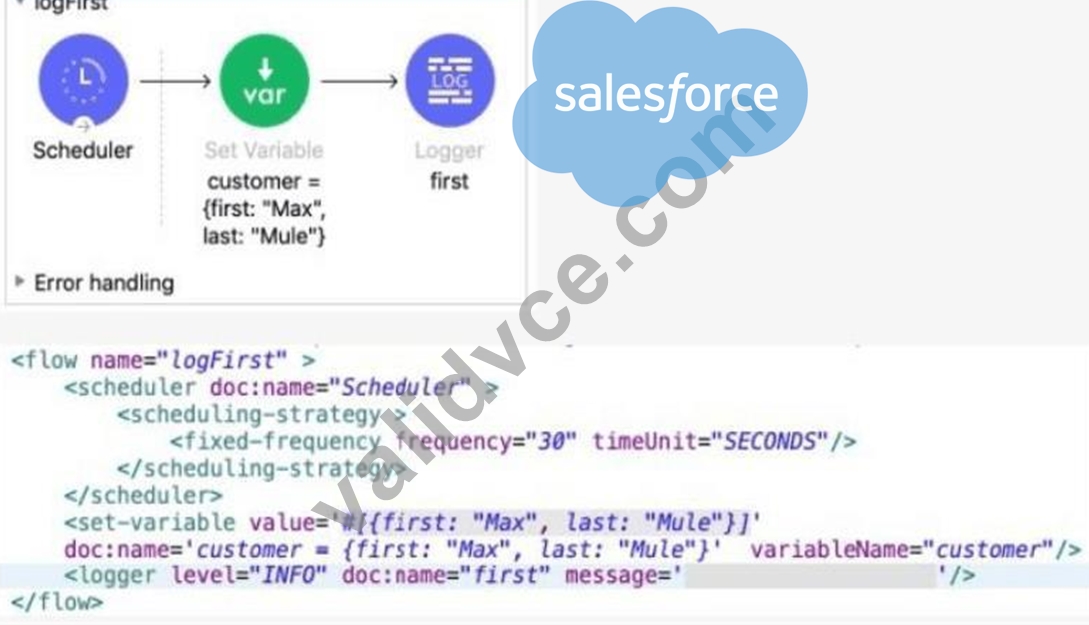
The Set Variable transformer is set with value #[ [ first "Max" last"Mule"} ].
What is a valid DataWeave expression to set as the message attribute of the Logger to access the value "Max" from the Mule event?
- A. "customer first"
- B. vars "customer" "first"
- C. vars "customer first"
- D. customer first
Answer: B
NEW QUESTION # 31
An API instance of type API endpoint with API proxy is created in API manager using an API specification from Anypoint Exchange. The API instance is also configured with an API proxy that is deployed and running in CloudHub.
An SLA- based policy is enabled in API manager for this API instance.
Where can an external API consumer obtain a valid client ID and client secret to successfully send requests to the API proxy?
- A. In Runtime Manager, from the properties tab of the deployed approved API proxy
- B. In Anypoint Studio, from components generated by APIkit for the API specification
- C. In the organization's public API portal in Anypoint Exchange, from an approved client application for the API proxy
- D. In Anypoint Studio, from components generated by Rest Connect for API specification
Answer: C
Explanation:
* When a client application is registered in Anypoint Platform, a pair of credentials consisting of a client ID and client secret is generated.
* When the client application requests access to an API, a contract is created between the application and that API.
* An API that is protected with a Client ID Enforcement policy is accessible only to applications that have an approved contract.
--------------------------------------------------------------------------------------------------------------------------------------------- Correct Answer: In the organization's public API portal in Anypoint Exchange, from
NEW QUESTION # 32
Refer to the exhibit. The main flow contains an HTTP Request in the middle of the flow. The HTTP Listeners and HTTP request use default configurations.
What
values are accessible to the Logger at the end of the flow after a web client submit request tohttp://local:801
/order?color=red?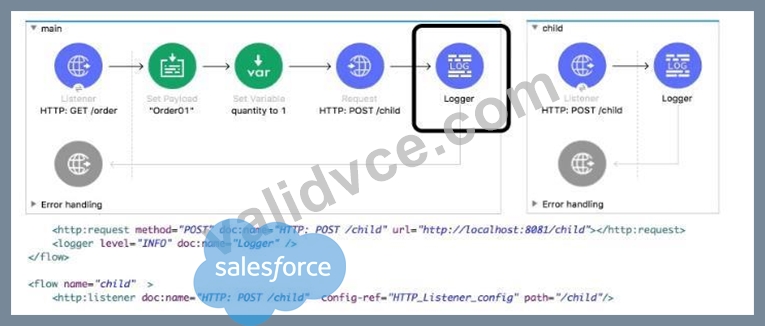
- A. payload color query param
- B. payload
- C. payload quantity var
- D. payload quantity var color query param
Answer: C
Explanation:
In this case as outbound call is made using HTTP: POST /child , all attributes will be replacedby this invocation. Hence query parameter will not be accessible at logger.
NEW QUESTION # 33
What is the minimum Cloudhub worker size that can be specified while deploying mule application?
- A. 1.0 vCores
- B. 0.2 vCores
- C. 0.1 vCores
- D. 0.5 vCores
Answer: C
Explanation:
Correct answer is 0.1 vCores
MuleSoft Doc Ref : https://docs.mulesoft.com/runtime-manager/cloudhub-architecture#cloudhub-workers CloudHub Workers Workers are dedicated instances of Mule runtime engine that run your integration applications on CloudHub. The memory capacity and processing power of a worker depends on how you configure it at the application level.
Worker sizes have different compute, memory, and storage capacities. You can scale workers vertically by selecting one of the available worker sizes: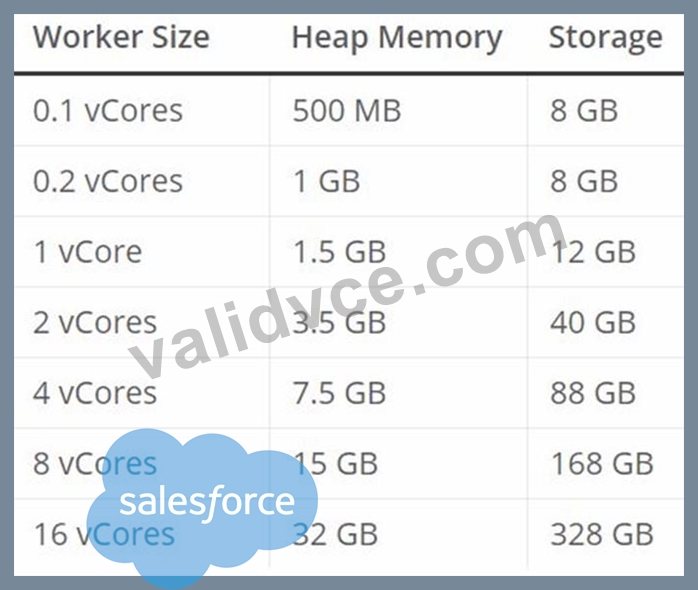
NEW QUESTION # 34
An organization is beginning to follow Mulesoft's recommended API led connectivity approach to use modern API to support the development and lifecycle of the integration solutions and to close the IT delivery gap.
What distinguishes between how modern API's are organized in a MuleSoft recommended API-led connectivity approach as compared to other common enterprise integration solutions?
- A. The API interfaces are specified at a granularity intended for developers to consume specific aspect of integration processes
- B. The API implementation are built with standards using common lifecycle and centralized configuration management tools
- C. The APIO implementations are monitored with common tools, centralized monitoring and security systems
- D. The API interfaces are specified as macroservices with one API representing all the business logic of an existing and proven end to end solution
Answer: A
Explanation:
Correct answer is The API interfaces are specified at a granularity intended for developers to consume specific aspect of integration processes
NEW QUESTION # 35
Refer to exhibits.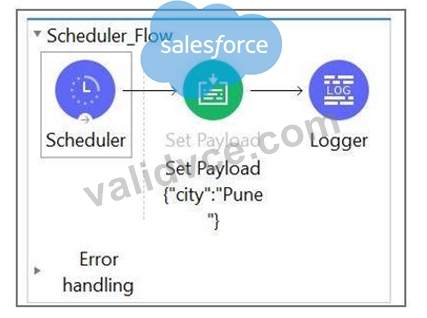
What message should be added to Logger component so that logger prints "The city is Pune" (Double quote should not be part of logged message)?
- A. The city is #[payload.City]
- B. #[The city is ${payload.City}
- C. #["The city is" ++ payload.City]
- D. The city is + #[payload.City]
Answer: A
Explanation:
Correct answer is The city is #[payload.City]
Answer can get confused with the option #["The city is" ++ payload.City] But note that this option will not print the space between is and city name. This will print The city isPune
NEW QUESTION # 36
WhichMule component provides a real-time, graphical representation of the APIs and mule applications that are running and discoverable?
- A. API Manager
- B. Anypoint Visualizer
- C. API Notebook
- D. Runtime Manager
Answer: B
Explanation:
Correct answer is Anypoint Visualizer
MuleSoft Doc Ref : https://docs.mulesoft.com/visualizer/
Anypoint Visualizer provides a real-time, graphical representation of the APIs, and Mule applications that are running and discoverable. It also displays third-party systems that are invoked by a Mule API, proxy, or application within your application network. The data displayed in the graph is dynamically updated and does not require prior configuration. Additionally, the data displayed is secure, as only users with the proper permissions can view the application network graph.
Diagram Description automatically generated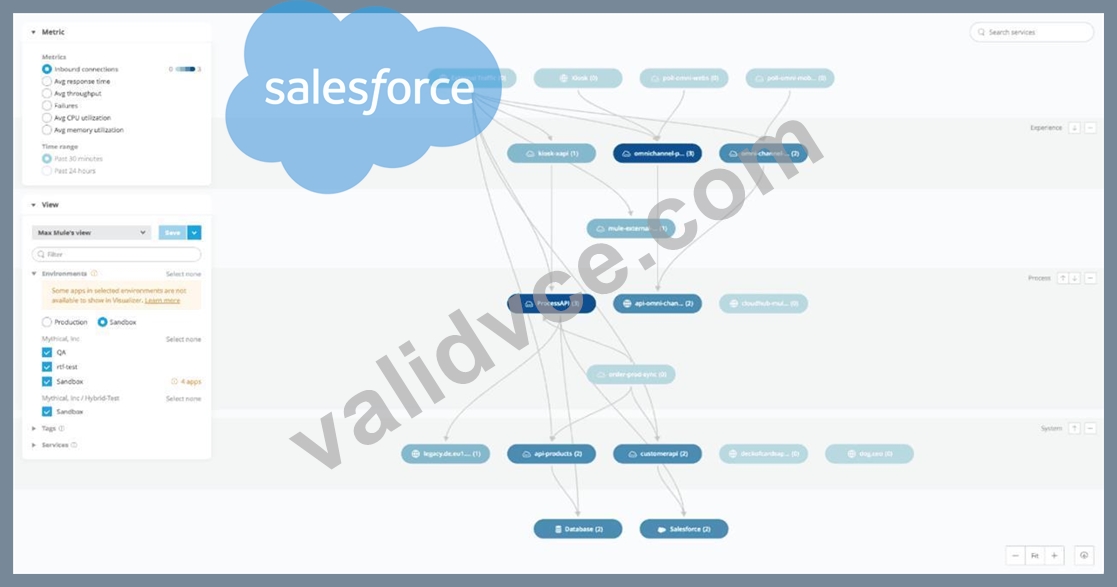
NEW QUESTION # 37
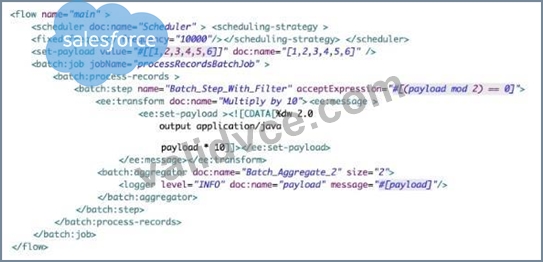
Refer to the exhibit. The Batch Job processes, filters and aggregates records, What is the expected output from the Logger component?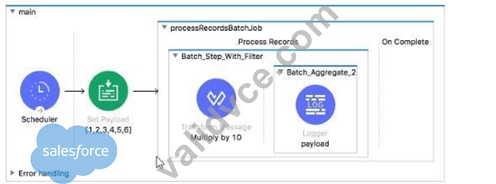
- A. [20, 40, 60]
- B. [10. 20] [30, 40] [50, 60]
- C. [20. 40] [60]
- D. [10. 20, 30. 40, 50, 60]
Answer: C
Explanation:
*Batch scope has filter criteria which says paylod mod 2 = 0 whch means only 2, 4 and 6 will be in batch scope.
* So payload for each of these will be incremented by 10.
* Aggregator has batch size defined as 2. So it will process in batch of two records.
* Hence option 3 is correct answer.
[20,40]
[60]
Behavior with aggregator configured with fixed size
In this scenario, the batch step sends the processed records to an aggregator, which starts processing the records and buffering them until the configuredaggregator's size is reached. After that, the aggregator sends the aggregated records to the stepping queue.
Diagram Description automatically generated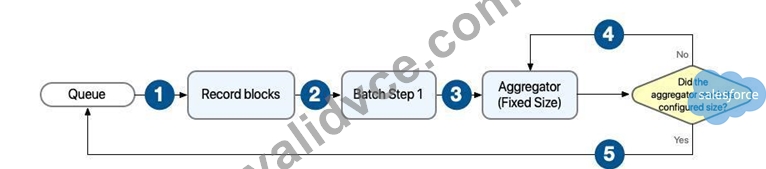
The batch job builds record blocks of the configured block size and sends them to their corresponding batch step for processing. Each batch stepreceives one or more record blocks and starts processing them in parallel.
After the batch step processes a record, the batch step sends the record to the aggregator for further processing. The aggregator continues processing records until the number of aggregated records reaches the configured aggregator's size.
https://docs.mulesoft.com/mule-runtime/4.3/batch-processing-concept
NEW QUESTION # 38
Refer to the exhibits.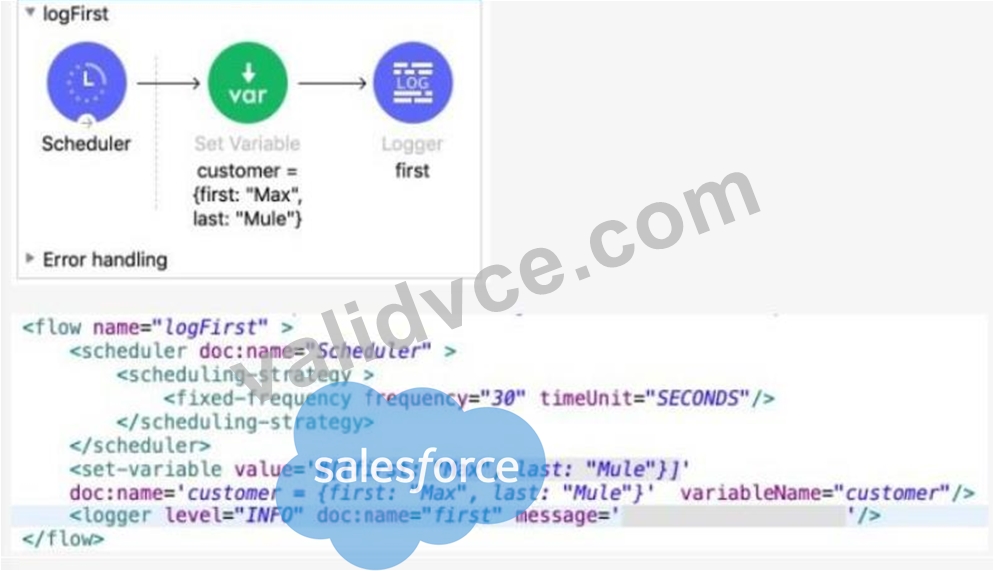
The Set Variable transformer is set with value #[ [ first "Max" last "Mule"} ].
What is a valid DataWeave expression to set as the message attribute of the Logger to access the value "Max" from the Mule event?
- A. "customer first"
- B. vars "customer" "first"
- C. vars "customer first"
- D. customer first
Answer: B
NEW QUESTION # 39
Refer to the exhibit.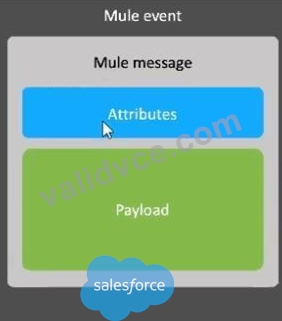
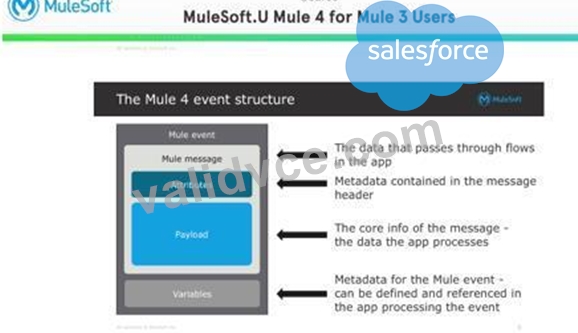
A Mule event is composed of a hierarchy of objects. Where in the hierarchy are variables stored?
- A. Mule message payload
- B. Mule message attributes
- C. Mule message
- D. Mule event
Answer: D
Explanation:
Variables are stored under Mule event. Please refer to below image for the hierarchy .
Graphical user interface Description automatically generated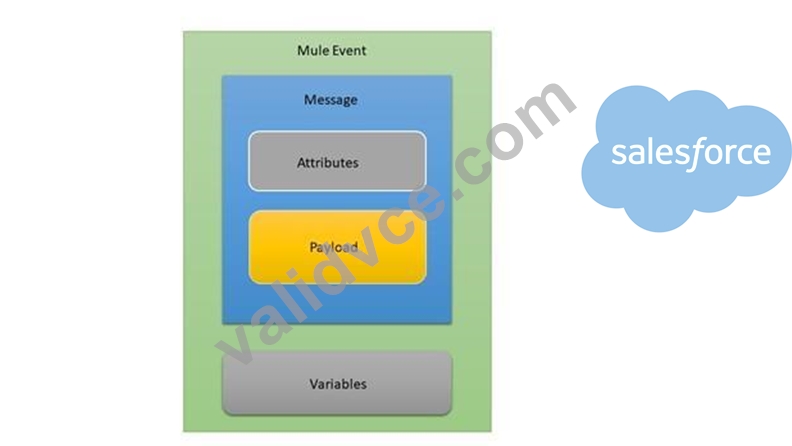
NEW QUESTION # 40
Refer to theexhibits.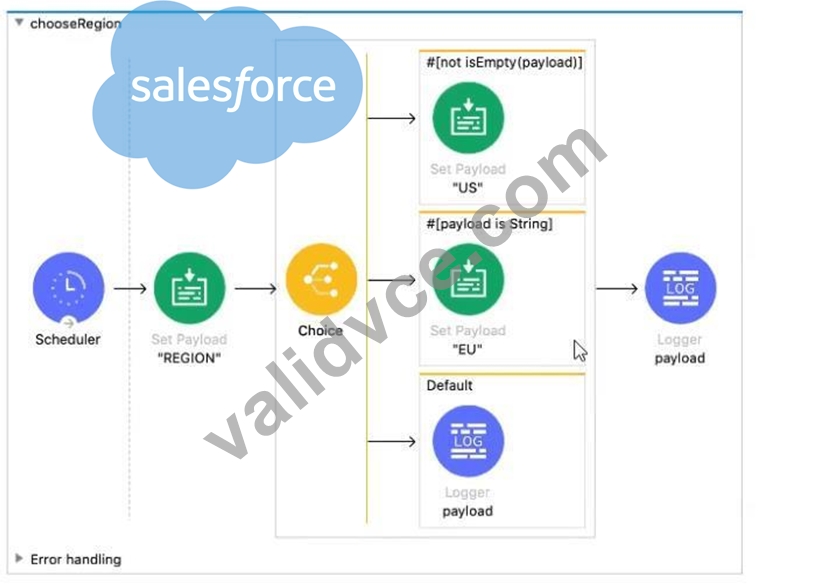
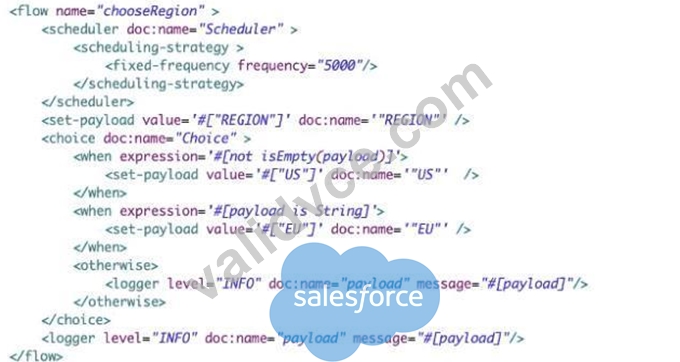
A Mule application contains a Choice router. What is logged when the flow completes?
- A. EU
- B. ["US", "EU"]
- C. US
- D. "REGION"
Answer: C
NEW QUESTION # 41
Refer to the exhibits.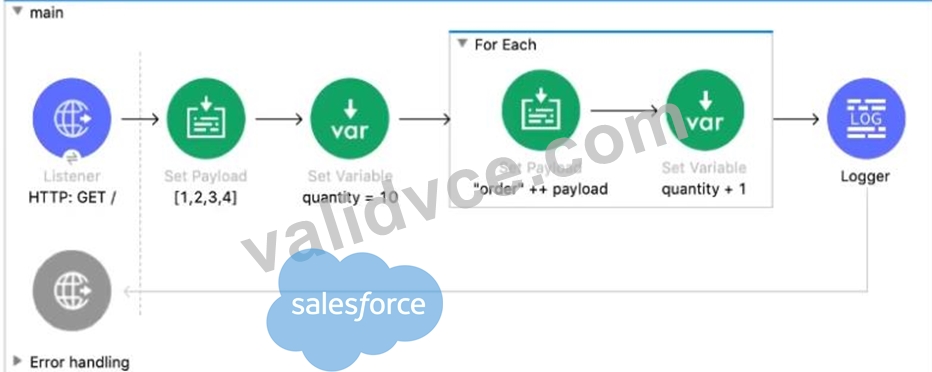
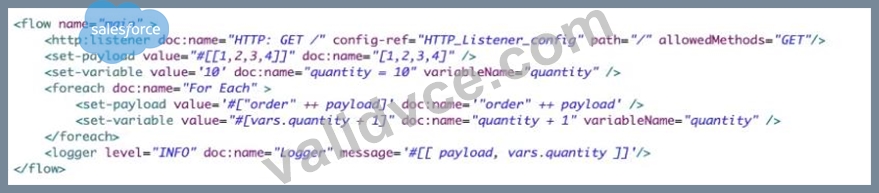
What payload and quantity are logged at the end of the main flow?
- A. [[1,2,3,4], 10]
- B. [orderlorder2order3order4,14]
- C. [[order1, order2, order3, order4], 14]
- D. [[1,2,3,4], 14]
Answer: D
NEW QUESTION # 42
Refer to the exhibits.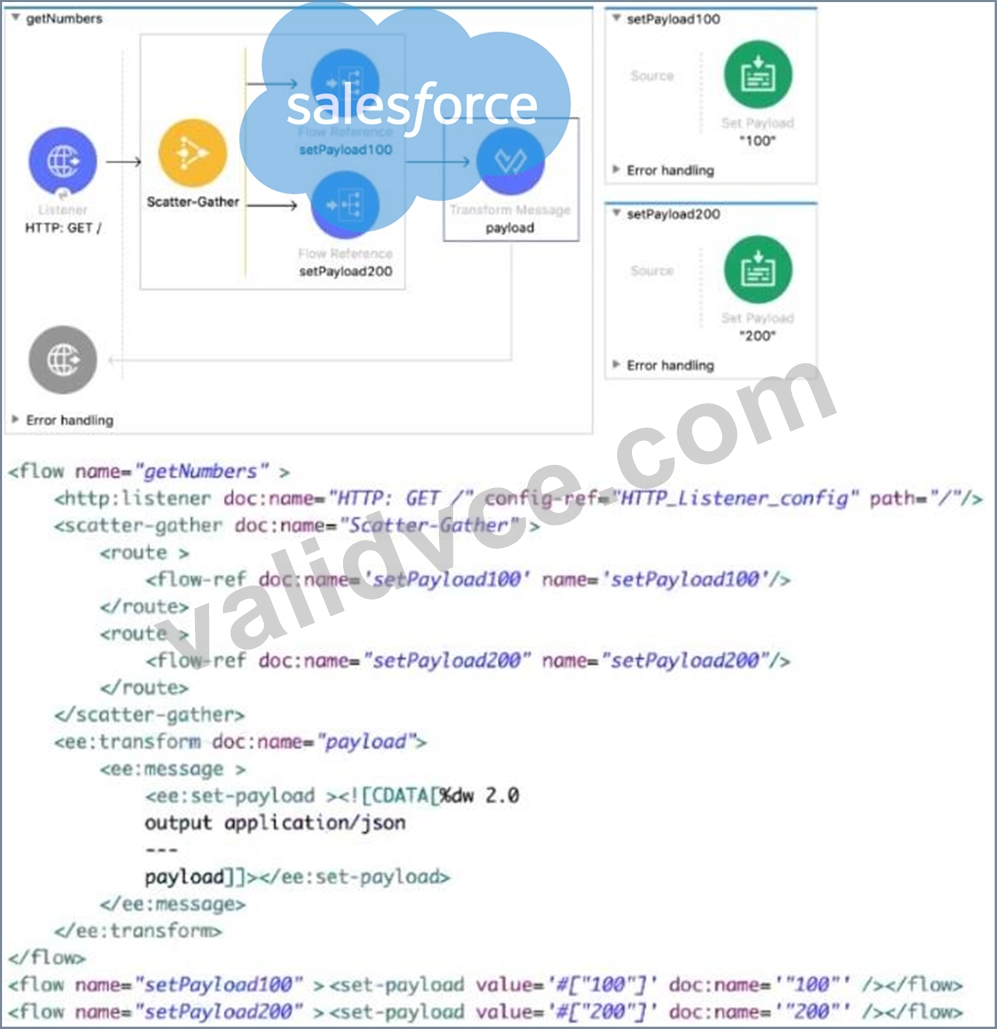
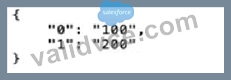
Each route in the Scatter-Gather sets the payload to the number shown in the label. What response is returned to a web client request to the HTTP Listener?
- A.
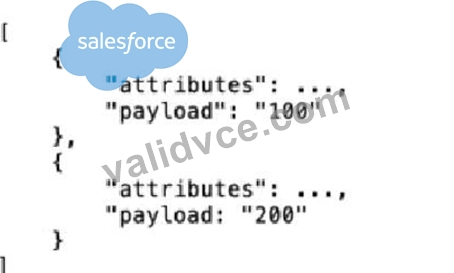
- B.
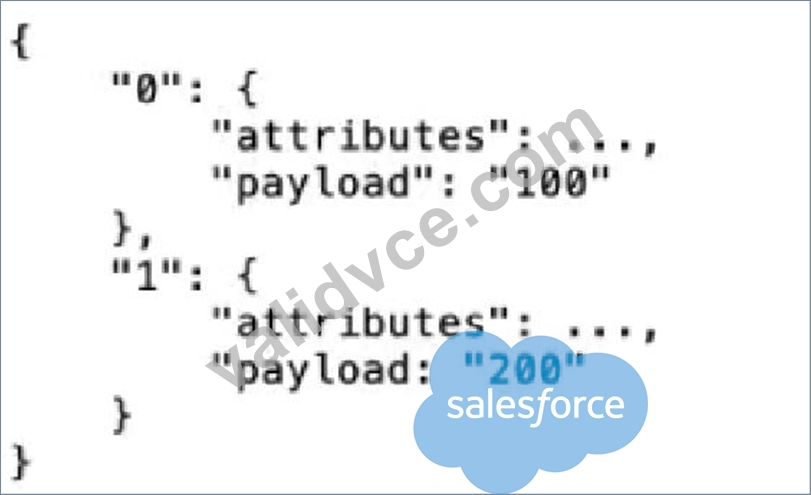
- C.

- D.
Answer: B
Explanation:
Correct answer is as below.
After all processing routes have finished execution, the Scatter-Gather component creates a new Mule event that combines all resulting Mule events from each route, and then passes the new Mule event to the next component in the flow.
{
"0": {
"attributes": ...,
"payload": "100"
},
"1": {
"attributes": ...,
"payload": "200"
}
}
Bottom of Form
NEW QUESTION # 43
What is not true about application properties?
- A. Application properties provide easier way to manage configurable values
- B. Application properties can be encrypted
- C. Application properties can be overridden with system properties
- D. Application properties can be defined in .yaml file only
Answer: D
Explanation:
Application properties can be defined in .yaml or in .properties file.
MuleSoft Doc Ref : https://docs.mulesoft.com/mule-runtime/4.3/configuring-properties#supported_files
NEW QUESTION # 44
An SLA based policy has been enabled in API Manager. What is the next step to configure the API proxy to enforce the new SLA policy?
- A. Add new property placeholders and redeploy the API proxy
- B. Restart the API proxy to clear the API policy cache
- C. Add required headers to the RAML specification and redeploy the new API proxy
- D. Add new environment variables and restart the API proxy
Answer: C
Explanation:
Correct answer is Add required headers to RAML specification and redeploy new API proxy MuleSoft Doc Ref : https://docs.mulesoft.com/api-manager/2.x/tutorial-manage-an-api Steps are as below :
Add the Required RAML Snippet
SLA-based rate limiting requires adding a RAML or OAS snippet to your API. This procedure demonstrates adding a RAML snippet.
Specify the client ID and secret as query parameters.
Add a section called traits: at the RAML root level to define query parameters:
traits:
-client-id-required:
queryParameters:
client_id:
type: string
client_secret:
type: string
Add the client-id-required trait to every method that requires these query parameters:
/users:
get:
is: [client-id-required]
description: Gets a list of JSONPlaceholder users.
Step 2 : Add the SLA Tier in API Manager
Step 3 : Apply the policy and redeploy
Reference:https://docs.mulesoft.com/api-manager/2.x/tutorial-manage-an-api
NEW QUESTION # 45
Refer to the exhibits.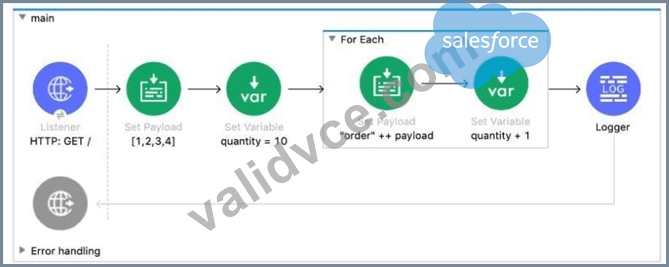
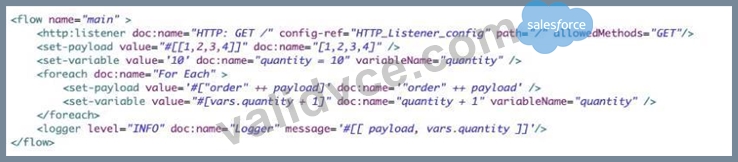
What payload and quantity are logged at the end of the main flow?
- A. [[1,2,3,4], 10]
- B. [orderlorder2order3order4,14]
- C. [[order1, order2, order3, order4], 14]
- D. [[1,2,3,4], 14]
Answer: D
NEW QUESTION # 46
A
web client submits a request tohttp://localhost:8081/books/0471767840. The value
"0471767840" is captured by a Set Variable transformer to a variable named booklSBN.
What is the DataWeave expression to access booklSBN later in the flow?
- A. booklSBN
- B. attributes.booklSBN
- C. vars. booklSBN
- D. flowVars.booklSBN
Answer: C
NEW QUESTION # 47
......
Download Real Salesforce Salesforce-MuleSoft-Developer-I Exam Dumps Test Engine Exam Questions: https://torrentpdf.validvce.com/Salesforce-MuleSoft-Developer-I-exam-collection.html
