

[Dec 14, 2025] Powerful ARA-C01 PDF Dumps for ARA-C01 Questions
Authentic ARA-C01 Dumps - Free PDF Questions to Pass
One of the unique features of the SnowPro Advanced Architect Certification exam is that it is an online, proctored exam. This means that candidates can take the exam from anywhere in the world, at any time, while being monitored by a proctor through a webcam. This format ensures the integrity and security of the exam, while also providing convenience and flexibility to candidates.
NEW QUESTION # 98
A company is designing high availability and disaster recovery plans and needs to maximize redundancy and minimize recovery time objectives for their critical application processes. Cost is not a concern as long as the solution is the best available. The plan so far consists of the following steps:
1. Deployment of Snowflake accounts on two different cloud providers.
2. Selection of cloud provider regions that are geographically far apart.
3. The Snowflake deployment will replicate the databases and account data between both cloud provider accounts.
4. Implementation of Snowflake client redirect.
What is the MOST cost-effective way to provide the HIGHEST uptime and LEAST application disruption if there is a service event?
- A. Connect the applications using the <organization_name>-<accountLocator> URL. Use the Business Critical Snowflake edition.
- B. Connect the applications using the <organization_name>-<accountLocator> URL. Use the Enterprise Snowflake edition.
- C. Connect the applications using the <organization_name>-<connection_name> URL. Use the Business Critical Snowflake edition.
- D. Connect the applications using the <organization_name>-<connection_name> URL. Use the Virtual Private Snowflake (VPS) edition.
Answer: A
Explanation:
To provide the highest uptime and least application disruption in case of a service event, the best option is to use the Business Critical Snowflake edition and connect the applications using the
<organization_name>-<accountLocator> URL. The Business Critical Snowflake edition offers the highest level of security, performance, and availability for Snowflake accounts. It includes features such as customer-managed encryption keys, HIPAA compliance, and 4-hour RPO and RTO SLAs. It also supports account replication and failover across regions and cloud platforms, which enables business continuity and disaster recovery. By using the <organization_name>-<accountLocator> URL, the applications can leverage the Snowflake Client Redirect feature, which automatically redirects the client connections to the secondary account in case of a failover. This way, the applications can seamlessly switch to the backup account without any manual intervention or configuration changes. The other options are less cost-effective or less reliable because they either use a lower edition of Snowflake, which does not support account replication and failover, or they use the <organization_name>-<connection_name> URL, which does not support client redirect and requires manual updates to the connection string in case of a failover. References:
* [Snowflake Editions] 1
* [Replication and Failover/Failback] 2
* [Client Redirect] 3
* [Snowflake Account Identifiers] 4
NEW QUESTION # 99
An Architect has designed a data pipeline that Is receiving small CSV files from multiple sources. All of the files are landing in one location. Specific files are filtered for loading into Snowflake tables using the copy command. The loading performance is poor.
What changes can be made to Improve the data loading performance?
- A. Create a multi-cluster warehouse and merge smaller files to create bigger files.
- B. Change the file format from CSV to JSON.
- C. Create a specific storage landing bucket to avoid file scanning.
- D. Increase the size of the virtual warehouse.
Answer: A
NEW QUESTION # 100
Refer to the exhibit.
Based on the architecture in the image, how can the data from DB1 be copied into TBL2? (Select TWO).
- A.
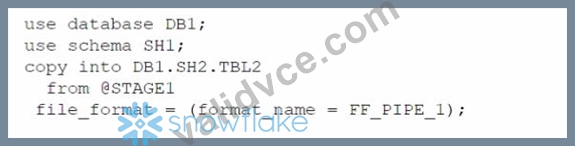
- B.

- C.

- D.
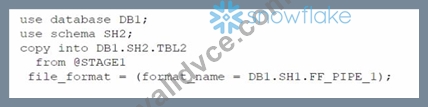
- E.
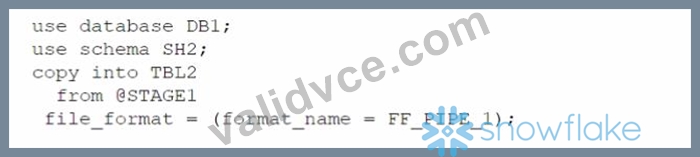
Answer: C,E
NEW QUESTION # 101
A healthcare company is deploying a Snowflake account that may include Personal Health Information (PHI). The company must ensure compliance with all relevant privacy standards.
Which best practice recommendations will meet data protection and compliance requirements? (Choose three.)
- A. Use the External Tokenization feature to obfuscate sensitive data.
- B. Avoid sharing data with partner organizations.
- C. Use, at minimum, the Business Critical edition of Snowflake.
- D. Create Dynamic Data Masking policies and apply them to columns that contain PHI.
- E. Use the Internal Tokenization feature to obfuscate sensitive data.
- F. Rewrite SQL queries to eliminate projections of PHI data based on current_role().
Answer: A,C,D
NEW QUESTION # 102
What are purposes for creating a storage integration? (Choose three.)
- A. Avoid supplying credentials when creating a stage or when loading or unloading data.
- B. Manage credentials from multiple cloud providers in one single Snowflake object.
- C. Store a generated identity and access management (IAM) entity for an external cloud provider regardless of the cloud provider that hosts the Snowflake account.
- D. Create private VPC endpoints that allow direct, secure connectivity between VPCs without traversing the public internet.
- E. Control access to Snowflake data using a master encryption key that is maintained in the cloud provider's key management service.
- F. Support multiple external stages using one single Snowflake object.
Answer: A,C,F
Explanation:
* A storage integration is a Snowflake object that stores a generated identity and access management (IAM) entity for an external cloud provider, such as Amazon S3, Google Cloud Storage, or Microsoft Azure Blob Storage. This integration allows Snowflake to read data from and write data to an external storage location referenced in an external stage1.
* One purpose of creating a storage integration is to support multiple external stages using one single Snowflake object. An integration can list buckets (and optional paths) that limit the locations users can specify when creating external stages that use the integration. Note that many external stage objects can reference different buckets and paths and use the same storage integration for authentication1.
Therefore, option C is correct.
* Another purpose of creating a storage integration is to avoid supplying credentials when creating a stage or when loading or unloading data. Integrations are named, first-class Snowflake objects that avoid the need for passing explicit cloud provider credentials such as secret keys or access tokens. Integration objects store an IAM user ID, and an administrator in your organization grants the IAM user permissions in the cloud provider account1. Therefore, option D is correct.
* A third purpose of creating a storage integration is to store a generated IAM entity for an external cloud provider regardless of the cloud provider that hosts the Snowflake account. For example, you can create a storage integration for Amazon S3 even if your Snowflake account is hosted on Azure or Google Cloud Platform. This allows you to access data across different cloud platforms using Snowflake1.
Therefore, option B is correct.
* Option A is incorrect, because creating a storage integration does not control access to Snowflake data using a master encryption key. Snowflake encrypts all data using a hierarchical key model, and the master encryption key is managed by Snowflake or by the customer using a cloud provider's key management service. This is independent of the storage integration feature2.
* Option E is incorrect, because creating a storage integration does not create private VPC endpoints.
Private VPC endpoints are a network configuration option that allow direct, secure connectivity between VPCs without traversing the public internet. This is also independent of the storage integration feature3.
* Option F is incorrect, because creating a storage integration does not manage credentials from multiple cloud providers in one single Snowflake object. A storage integration is specific to one cloud provider, and you need to create separate integrations for each cloud provider you want to access4.
References: : Encryption and Decryption : Private Link for Snowflake : CREATE STORAGE INTEGRATION : Option 1: Configuring a Snowflake Storage Integration to Access Amazon S3
NEW QUESTION # 103
While loading data into a table from stage, which are the valid copyOptions
- A. ABORT_STATEMENT
- B. CONTINUE
- C. SKIP_FILE
- D. SKIP_FILE_<NUM>
- E. ERROR_STATEMENT
- F. SKIP_FILE_<NUM>%
Answer: A,B,C,D,F
NEW QUESTION # 104
What step will im the performance of queries executed against an external table?
- A. Use an internal stage instead of an external stage to store the source files.
- B. Partition the external table.
- C. Convert the source files' character encoding to UTF-8.
- D. Shorten the names of the source files.
Answer: B
Explanation:
Partitioning an external table is a technique that improves the performance of queries executed against the table by reducing the amount of data scanned. Partitioning an external table involves creating one or more partition columns that define how the table is logically divided into subsets of data based on the values in those columns. The partition columns can be derived from the file metadata (such as file name, path, size, or modification time) or from the file content (such as a column value or a JSON attribute). Partitioning an external table allows the query optimizer to prune the files that do not match the query predicates, thus avoiding unnecessary data scanning and processing2 The other options are not effective steps for improving the performance of queries executed against an external table:
* Shorten the names of the source files. This option does not have any impact on the query performance, as the file names are not used for query processing. The file names are only used for creating the external table and displaying the query results3
* Convert the source files' character encoding to UTF-8. This option does not affect the query performance, as Snowflake supports various character encodings for external table files, such as UTF-8, UTF-16, UTF-32, ISO-8859-1, and Windows-1252. Snowflake automatically detects the character encoding of the files and converts them to UTF-8 internally for query processing4
* Use an internal stage instead of an external stage to store the source files. This option is not applicable, as external tables can only reference files stored in external stages, such as Amazon S3, Google Cloud
* Storage, or Azure Blob Storage. Internal stages are used for loading data into internal tables, not external tables5 References:
* 1: SnowPro Advanced: Architect | Study Guide
* 2: Snowflake Documentation | Partitioning External Tables
* 3: Snowflake Documentation | Creating External Tables
* 4: Snowflake Documentation | Supported File Formats and Compression for Staged Data Files
* 5: Snowflake Documentation | Overview of Stages
* : SnowPro Advanced: Architect | Study Guide
* : Partitioning External Tables
* : Creating External Tables
* : Supported File Formats and Compression for Staged Data Files
* : Overview of Stages
NEW QUESTION # 105
You can define a clustering key directly on top of VARIANT columns
- A. TRUE
- B. FALSE
Answer: B
NEW QUESTION # 106
A company's Architect needs to find an efficient way to get data from an external partner, who is also a Snowflake user. The current solution is based on daily JSON extracts that are placed on an FTP server and uploaded to Snowflake manually. The files are changed several times each month, and the ingestion process needs to be adapted to accommodate these changes.
What would be the MOST efficient solution?
- A. Ask the partner to create a share and add the company's account.
- B. Ask the partner to use the data lake export feature and place the data into cloud storage where Snowflake can natively ingest it (schema-on-read).
- C. Keep the current structure but request that the partner stop changing files, instead only appending new files.
- D. Ask the partner to set up a Snowflake reader account and use that account to get the data for ingestion.
Answer: A
Explanation:
The most efficient solution is to ask the partner to create a share and add the company's account (Option A). This way, the company can access the live data from the partner without any data movement or manual intervention. Snowflake's secure data sharing feature allows data providers to share selected objects in a database with other Snowflake accounts. The shared data is read-only and does not incur any storage or compute costs for the data consumers. The data consumers can query the shared data directly or create local copies of the shared objects in their own databases. Option B is not efficient because it involves using the data lake export feature, which is intended for exporting data from Snowflake to an external data lake, not for importing data from another Snowflake account. The data lake export feature also requires the data provider to create an external stage on cloud storage and use the COPY INTO <location> command to export the data into parquet files. The data consumer then needs to create an external table or a file format to load the data from the cloud storage into Snowflake. This process can be complex and costly, especially if the data changes frequently. Option C is not efficient because it does not solve the problem of manual data ingestion and adaptation. Keeping the current structure of daily JSON extracts on an FTP server and requesting the partner to stop changing files, instead only appending new files, does not improve the efficiency or reliability of the data ingestion process. The company still needs to upload the data to Snowflake manually and deal with any schema changes or data quality issues. Option D is not efficient because it requires the partner to set up a Snowflake reader account and use that account to get the data for ingestion. A reader account is a special type of account that can only consume data from the provider account that created it. It is intended for data consumers who are not Snowflake customers and do not have a licensing agreement with Snowflake. A reader account is not suitable for data ingestion from another Snowflake account, as it does not allow uploading, modifying, or unloading data. The company would need to use external tools or interfaces to access the data from the reader account and load it into their own account, which can be slow and expensive. Reference: The answer can be verified from Snowflake's official documentation on secure data sharing, data lake export, and reader accounts available on their website. Here are some relevant links:
Introduction to Secure Data Sharing | Snowflake Documentation
Data Lake Export Public Preview Is Now Available on Snowflake | Snowflake Blog Managing Reader Accounts | Snowflake Documentation
NEW QUESTION # 107
You have create a task as below
CREATE TASK mytask1
WAREHOUSE = mywh
SCHEDULE = '5 minute'
WHEN
SYSTEM$STREAM_HAS_DATA('MYSTREAM')
AS
INSERT INTO mytable1(id,name) SELECT id, name FROM mystream WHERE METADATA$ACTION = 'INSERT';
Which statement is true below?
- A. If SYSTEM$STREAM_HAS_DATA returns false, the task will be skipped
- B. If SYSTEM$STREAM_HAS_DATA returns false, the task will go to suspended mode
- C. If SYSTEM$STREAM_HAS_DATA returns false, the task will still run
Answer: A
NEW QUESTION # 108
Which system functions does Snowflake provide to monitor clustering information within a table (Choose two.)
- A. SYSTEM$CLUSTERING_KEYS
- B. SYSTEM$CLUSTERING_INFORMATION
- C. SYSTEM$CLUSTERING_USAGE
- D. SYSTEM$CLUSTERING_PERCENT
- E. SYSTEM$CLUSTERING_DEPTH
Answer: B,E
NEW QUESTION # 109
A table, EMP_ TBL has three records as shown: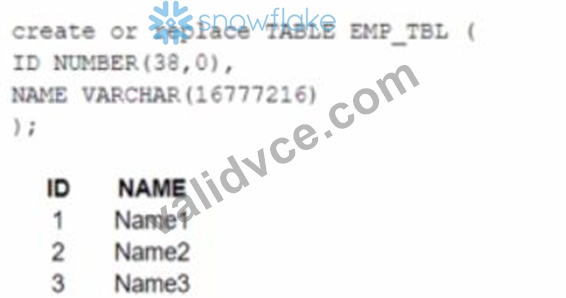
The following variables are set for the session:
Which SELECT statements will retrieve all three records? (Select TWO).
- A. Select * FROM Stbl_ref WHERE Scol_ref IN ('Name1','Nam2','Name3');
- B. SELECT * FROM EMP_TBL WHERE identifier(Scol_ref) IN ('Namel','Name2', 'Name3');
- C. SELECT * FROM identifier($tbl_ref) WHERE ID IN Cvarl','var2','var3');
- D. SELECT * FROM identifier<Stbl_ref> WHERE NAME IN ($var1, $var2, $var3);
- E. SELECT * FROM $tb1_ref WHERE $col_ref IN ($var1, Svar2, Svar3);
Answer: B,E
Explanation:
The correct answer is B and E because they use the correct syntax and values for the identifier function and the session variables.
The identifier function allows you to use a variable or expression as an identifier (such as a table name or column name) in a SQL statement. It takes a single argument and returns it as an identifier. For example, identifier($tbl_ref) returns EMP_TBL as an identifier.
The session variables are set using the SET command and can be referenced using the $ sign. For example, $var1 returns Name1 as a value.
Option A is incorrect because it uses Stbl_ref and Scol_ref, which are not valid session variables or identifiers. They should be $tbl_ref and $col_ref instead.
Option C is incorrect because it uses identifier<Stbl_ref>, which is not a valid syntax for the identifier function. It should be identifier($tbl_ref) instead.
Option D is incorrect because it uses Cvarl, var2, and var3, which are not valid session variables or values. They should be $var1, $var2, and $var3 instead. Reference:
Snowflake Documentation: Identifier Function
Snowflake Documentation: Session Variables
Snowflake Learning: SnowPro Advanced: Architect Exam Study Guide
NEW QUESTION # 110
Create a task and a stream following the below steps. So, when the
system$stream_has_data('rawstream1') condition returns false, what will happen to the task ?
-- Create a landing table to store raw JSON data.
-- Snowpipe could load data into this table. create or replace table raw (var variant);
-- Create a stream to capture inserts to the landing table.
-- A task will consume a set of columns from this stream. create or replace stream rawstream1 on table raw;
-- Create a second stream to capture inserts to the landing table.
-- A second task will consume another set of columns from this stream. create or replace stream rawstream2 on table raw;
-- Create a table that stores the names of office visitors identified in the raw data. create or replace table names (id int, first_name string, last_name string);
-- Create a table that stores the visitation dates of office visitors identified in the raw data.
create or replace table visits (id int, dt date);
-- Create a task that inserts new name records from the rawstream1 stream into the names table
-- every minute when the stream contains records.
-- Replace the 'etl_wh' warehouse with a warehouse that your role has USAGE privilege on. create or replace task raw_to_names
warehouse = etl_wh schedule = '1 minute' when
system$stream_has_data('rawstream1') as
merge into names n
using (select var:id id, var:fname fname, var:lname lname from rawstream1) r1 on n.id = to_number(r1.id)
when matched then update set n.first_name = r1.fname, n.last_name = r1.lname
when not matched then insert (id, first_name, last_name) values (r1.id, r1.fname, r1.lname)
;
-- Create another task that merges visitation records from the rawstream1 stream into the visits table
-- every minute when the stream contains records.
-- Records with new IDs are inserted into the visits table;
-- Records with IDs that exist in the visits table update the DT column in the table.
-- Replace the 'etl_wh' warehouse with a warehouse that your role has USAGE privilege on. create or replace task raw_to_visits
warehouse = etl_wh schedule = '1 minute' when
system$stream_has_data('rawstream2') as
merge into visits v
using (select var:id id, var:visit_dt visit_dt from rawstream2) r2 on v.id = to_number(r2.id) when matched then update set v.dt = r2.visit_dt
when not matched then insert (id, dt) values (r2.id, r2.visit_dt)
;
-- Resume both tasks.
alter task raw_to_names resume;
alter task raw_to_visits resume;
-- Insert a set of records into the landing table. insert into raw
select parse_json(column1) from values
('{"id": "123","fname": "Jane","lname": "Smith","visit_dt": "2019-09-17"}'),
('{"id": "456","fname": "Peter","lname": "Williams","visit_dt": "2019-09-17"}');
-- Query the change data capture record in the table streams select * from rawstream1;
select * from rawstream2;
- A. Task will return an warning message
- B. Task will be executed but no rows will be merged
- C. Task will be skipped
Answer: C
NEW QUESTION # 111
How can an Architect enable optimal clustering to enhance performance for different access paths on a given table?
- A. Create multiple materialized views with different cluster keys.
- B. Create multiple clustering keys for a table.
- C. Create super projections that will automatically create clustering.
- D. Create a clustering key that contains all columns used in the access paths.
Answer: A
Explanation:
According to the SnowPro Advanced: Architect documents and learning resources, the best way to enable optimal clustering to enhance performance for different access paths on a given table is to create multiple materialized views with different cluster keys. A materialized view is a pre-computed result set that is derived from a query on one or more base tables. A materialized view can be clustered by specifying a clustering key, which is a subset of columns or expressions that determines how the data in the materialized view is co- located in micro-partitions. By creating multiple materialized views with different cluster keys, an Architect can optimize the performance of queries that use different access paths on the same base table. For example, if a base table has columns A, B, C, and D, and there are queries that filter on A and B, or on C and D, or on A and C, the Architect can create three materialized views, each with a different cluster key: (A, B), (C, D), and (A, C). This way, each query can leverage the optimal clustering of the corresponding materialized view and achieve faster scan efficiency and better compression.
Snowflake Documentation: Materialized Views
Snowflake Learning: Materialized Views
https://www.snowflake.com/blog/using-materialized-views-to-solve-multi-clustering-performance-problems/
NEW QUESTION # 112
A company needs to have the following features available in its Snowflake account:
1. Support for Multi-Factor Authentication (MFA)
2. A minimum of 2 months of Time Travel availability
3. Database replication in between different regions
4. Native support for JDBC and ODBC
5. Customer-managed encryption keys using Tri-Secret Secure
6. Support for Payment Card Industry Data Security Standards (PCI DSS)
In order to provide all the listed services, what is the MINIMUM Snowflake edition that should be selected during account creation?
- A. Enterprise
- B. Standard
- C. Virtual Private Snowflake (VPS)
- D. Business Critical
Answer: D
NEW QUESTION # 113
An Architect is designing a data lake with Snowflake. The company has structured, semi-structured, and unstructured data. The company wants to save the data inside the data lake within the Snowflake system. The company is planning on sharing data among its corporate branches using Snowflake data sharing.
What should be considered when sharing the unstructured data within Snowflake?
- A. A scoped URL should be used to save the unstructured data into Snowflake in order to share data over secure views, with a 24-hour time limit for the URL.
- B. A file URL should be used to save the unstructured data into Snowflake in order to share data over secure views, with a 7-day time limit for the URL.
- C. A pre-signed URL should be used to save the unstructured data into Snowflake in order to share data over secure views, with no time limit for the URL.
- D. A file URL should be used to save the unstructured data into Snowflake in order to share data over secure views, with the "expiration_time" argument defined for the URL time limit.
Answer: A
Explanation:
When sharing unstructured data within Snowflake, using a scoped URL is recommended. Scoped URLs provide temporary access to staged files without granting privileges to the stage itself, enhancing security. The URL expires when the persisted query result period ends, which is currently set to 24 hours. This approach is suitable for sharing unstructured data over secure views within Snowflake's data sharing framework.
NEW QUESTION # 114
Which steps are recommended best practices for prioritizing cluster keys in Snowflake? (Choose two.)
- A. Choose cluster columns that are most actively used in selective filters.
- B. Choose cluster columns that are actively used in the GROUP BY clauses.
- C. Choose columns that are frequently used in join predicates.
- D. Choose TIMESTAMP columns with nanoseconds for the highest number of unique rows.
- E. Choose lower cardinality columns to support clustering keys and cost effectiveness.
Answer: A,C
Explanation:
According to the Snowflake documentation, the best practices for choosing clustering keys are:
* Choose columns that are frequently used in join predicates. This can improve the join performance by reducing the number of micro-partitions that need to be scanned and joined.
* Choose columns that are most actively used in selective filters. This can improve the scan efficiency by skipping micro-partitions that do not match the filter predicates.
* Avoid using low cardinality columns, such as gender or country, as clustering keys. This can result in poor clustering and high maintenance costs.
* Avoid using TIMESTAMP columns with nanoseconds, as they tend to have very high cardinality and low correlation with other columns. This can also result in poor clustering and high maintenance costs.
* Avoid using columns with duplicate values or NULLs, as they can cause skew in the clustering and reduce the benefits of pruning.
* Cluster on multiple columns if the queries use multiple filters or join predicates. This can increase the chances of pruning more micro-partitions and improve the compression ratio.
* Clustering is not always useful, especially for small or medium-sized tables, or tables that are not frequently queried or updated. Clustering can incur additional costs for initially clustering the data and maintaining the clustering over time.
Clustering Keys & Clustered Tables | Snowflake Documentation
[Considerations for Choosing Clustering for a Table | Snowflake Documentation]
NEW QUESTION # 115
You have a medium warehouse with auto suspend of 5 minutes. You ran a query on table#1. After 10 minutes, you ran a query that joins table#1 and table#2, but you see that the query did not use data
cache.
Why?
- A. Joins cannot use any type of cache
- B. When a warehouse is suspended, it may lose its data cache
- C. The query that ran the second time is completely different from query that ran on table#1, hence it will not be able to use data cache
Answer: B
NEW QUESTION # 116
A retail company has 2000+ stores spread across the country. Store Managers report that they are having trouble running key reports related to inventory management, sales targets, payroll, and staffing during business hours. The Managers report that performance is poor and time-outs occur frequently.
Currently all reports share the same Snowflake virtual warehouse.
How should this situation be addressed? (Select TWO).
- A. Configure the virtual warehouse to size 4-XL
- B. Configure a dedicated virtual warehouse for the Store Manager team.
- C. Use a Business Intelligence tool for in-memory computation to improve performance.
- D. Advise the Store Manager team to defer report execution to off-business hours.
- E. Configure the virtual warehouse to be multi-clustered.
Answer: B,E
Explanation:
The best way to address the performance issues and time-outs faced by the Store Manager team is to configure a dedicated virtual warehouse for them and make it multi-clustered. This will allow them to run their reports independently from other workloads and scale up or down the compute resources as needed. A dedicated virtual warehouse will also enable them to apply specific security and access policies for their data.
A multi-clustered virtual warehouse will provide high availability and concurrency for their queries and avoid queuing or throttling.
Using a Business Intelligence tool for in-memory computation may improve performance, but it will not solve the underlying issue of insufficient compute resources in the shared virtual warehouse. It will also introduce additional costs and complexity for the data architecture.
Configuring the virtual warehouse to size 4-XL may increase the performance, but it will also increase the cost and may not be optimal for the workload. It will also not address the concurrency and availability issues that may arise from sharing the virtual warehouse with other workloads.
Advising the Store Manager team to defer report execution to off-business hours may reduce the load on the shared virtual warehouse, but it will also reduce the timeliness and usefulness of the reports for the business.
It will also not guarantee that the performance issues and time-outs will not occur at other times.
References:
Snowflake Architect Training
Snowflake SnowPro Advanced Architect Certification - Preparation Guide
SnowPro Advanced: Architect Exam Study Guide
NEW QUESTION # 117
You have created a table as below
CREATE TABLE SNOWFLAKE_BLOG(BLOG_ID NUMBER, BLOG_CONTENT VARCHAR,BLOG_AUTHOR VARCHAR,BLOG_CREATE_DATE TIMESTAMP );
Now you want to cluster it by BLOG_AUTHOR and BLOG_CREATE_DATE.
Which command below will you choose?
- A. ALTER TABLE SNOWFLAKE_BLOG CLUSTER BY (BLOG_CREATE_DATE);
- B. ALTER TABLE SNOWFLAKE_BLOG CLUSTER BY (BLOG_AUTHOR, BLOG_CREATE_DATE);
- C. ALTER TABLE SNOWFLAKE_BLOG CLUSTER BY (BLOG_AUTHOR)
Answer: B
NEW QUESTION # 118
......
Guaranteed Accomplishment with Newest Dec-2025 FREE: https://torrentpdf.validvce.com/ARA-C01-exam-collection.html
