

Released CIPS L4M5 Updated Questions PDF
L4M5 Dumps and Practice Test (165 Exam Questions)
NEW QUESTION 22
One difference between perfect competition and monopolistic competition is that...?
- A. In perfect competition, firms produce slightly differentiated products
- B. Monopolistic competition has no barriers to entry
- C. A perfectly competitive industry has fewer firms.
- D. Firms in monopolistic competition face a downward-sloping demand curve
Answer: D
Explanation:
Explanation
Monopolistic competition exists in market where there are many competing producers but they will try to use product differentiation. Although their products may be very similar, their ability to differentiate means that they can act as monopolies in short run, irrespective of the actions of their competitors.
In perfect competition, there are no barriers to entry to the market or exit from the market. In monopolistic competition, there tend to be fewer barriers to entry or exit in these markets than in oligopolistic markets, but it doesn't mean that there are absolutely no barriers to entry in monopolistic competition.
In perfect competition, the demand curve is perfectly elastic, which means that it will be horizontal.
Otherwise, in monopolistic competition market, the demand curve will have normal downward slope.
LO 2, AC 2.2
NEW QUESTION 23
Stalemate is morelikely to happen if both parties trade more variables in a commercial negotiation. Is this assumption true?
- A. No, because the party who offers more variables will have lower bargaining power
- B. No, because more variables will facilitate more possible negotiated outcomes
- C. Yes, because more variables will cause more conflicts of interest
- D. Yes, because the negotiation will last endlessly if there aretoo many variables
Answer: B
Explanation:
Explanation
Negotiation variables such as price or contract length, etc arethat can be traded with TOP in a negotiation. The more variables you can identify, the better. The more variables you can identify and articulate, the lower the chances of the negotiation reaching deadlock as more possibilities are facilitated regarding more creative solutions.
Below are examples of negotiation tradeables in buying professional services:
Table Description automatically generated
Table Description automatically generated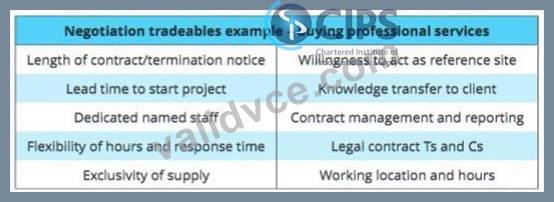
LO 2, AC 2.3
NEW QUESTION 24
The trust is built based on the other party's professional qualifications or proven or certified technical capability or experience is known as...?
- A. Competence trust
- B. Goodwill trust
- C. Contractual trust
- D. Irrevocable Trust
Answer: A
Explanation:
Trust is the expectation that the other party will behave in a predictable and mutually acceptable way. In inter-firm relationships, the presence and absence of trust can affect the level of cost in a relationship. The existence of trust is taught to lower the transaction cost in a relationship. Dr. Mari Sako identified taxonomy of
3 types of trust in commercial relationship, which is very useful from the perspective of procurement.
Contractual trust: Trust based on the contract with TOP. This is potentially the weakest source of trust if there is nothing else to base the trust on, but it is the quickest to establish.
Competence trust: Trust based on TOP's professional qualifications or proven or certified technical capability or experience.
Goodwilltrust: Trust based on knowing TOP has your interest at heart and will not behave opportunistically.
This is potentially the strongest type of trust, but it takes the longest time to build.
NEW QUESTION 25
An organisation is developing the specification for a capital purchase project. An important stakeholder has doubt on the draft specification. The buyer invites him to the product function meetings. In these meeting the attendees can raise their concerns, the specification development team takes in all the concerns and adjusts the specification accordingly. What kind of technique is the specification development team using?
- A. Persuasive reasoning
- B. Visionary
- C. Directive
- D. Coalition
Answer: D
Explanation:
In the scenario, anyone who has concerns can join a meeting to raise their thoughts. The project team takes the stakeholders' ideas into account. This isknown as coalition: A group of people or organisations come together and work collaboratively to achieve some goals. Specifically in this scenario, the goal is creating a high-quality and unified specification for an important project.
NEW QUESTION 26
According French and Raven's base model, which of the following are sources of personal power that can be used in commercial negotiation? Select THREE that apply.
- A. Expert power
- B. Legitimate power
- C. Competitive power
- D. Coercive power
- E. Trademark power
- F. Purchasing spend power
Answer: A,B,D
Explanation:
A useful model of personal power that has survived the test of time and provide a simple way to analyse negotiation in French and Raven's Power BaseModel, which describes six bases of power:
Diagram Description automatically generated
NEW QUESTION 27
A buying organisation with a low spend but the reputation for paying on-time. In order to increase buyer's leverage in negotiation with suppliers, which of the following should be a priority of this buyer?
- A. Volume separation
- B. Unavailable technical support
- C. Spend concentration
- D. Unclear tender award criteria
Answer: C
Explanation:
Explanation
According to Paul Steele's 'The Seller's Perspective', customer can be classified into 4 categories as below:
To increase theleverage in negotiation, buyer may increase its attractiveness and/or increase spend value. In this scenario, the buyer is already attractive to supplier as it always pays on-time, but the spend is still low. So to have greater leverage, the buyer has toincrease its spend volume by spend concentration. Spend concentration may take many forms as following:
- Vendor base reduction
- Volume pooling
- Volume redistribution
- Volume consolidation across categories
- Standardisation and harmonisation of specifications
- Forming purchasing consortia
Chart, treemap chart Description automatically generated
LO 1, AC 1.3
NEW QUESTION 28
In which of the following persuasion methods, the influencer uses logics and objective reasons to persuade the others to buy intoinfluencer's ideas?
- A. Persuasive reasoning (push)
- B. Visionary (pull)
- C. Directive (push)
- D. Collaborative (pull)
Answer: A
Explanation:
There are two major persuasion methods: 'push' and 'pull'.
Persuasion can be defined as encouraging someone to do something that you want them to do for you.
Persuasion is reasoning with someone so that they will believe or do something they might not otherwise do.
Persuasion can be considered as 'pushing' on TOP so that they can accept the change in attitude or behaviour as a result of your actions.
Influence is the ability to affect the manner of thinking of another. Influence can be considered as pulling on TOP so that you achieve the same result, but TOP feels they have changed their attitude or behaviour as a resultof their reflection and thinking, and not your direct actions.
There are multiple variables to consider when choosing between 'push' and 'pull'. Professor Fiona Dent of Ashridge Business School proposes situations when each style might be most appropriate, breaking down push into 'directive' and 'reasoning' and 'pull' into 'collaborative' and 'visionary':
Table Description automatically generated
Text Description automatically generated
Using logical and objective reasons is one of the typical characteristics of persuasion reasoning method.
NEW QUESTION 29
A public agency opens a tendering process for a road building project that lasts approximately 1 year. They post theirrequirements on public journal and receive some interests. After conducting due diligence process and selecting the lowest bidder, the project commences. However, the supplier complains that price of material increases because of a shortage of supply, thenthey demands an 5% uptick in contract value. The agency investigates the increment and sees that there is indeed a fluctuation in prices of supplier's input. They are likely to accept the proposal, but they are also concerned that supplier may demand more. To avoid making another concession with the supplier, which of the following should be a priority action of the agency?
- A. Disapprove supplier's demands until they finish the project
- B. Postpone the decision making until the budget is ready
- C. Document a contract variationthat only allows another concession if some specific conditions arise
- D. Seek approval from higher authority
Answer: C
Explanation:
Explanation
The agency (buyer) has made a concession about the price. Possibly the supplier will request another concession (the salami tactics). To avoid this to be happened, the agency should only allow a concession as an exception, make sure that the concession is documented and only permitted against some exceptional circumstances, and seek agreement to this from the supplier.
LO 3, AC 3.2
NEW QUESTION 30
Which of the following is most likely a consequence of falling interest rate?
- A. Decrease investment
- B. Increase aggregate demand
- C. Decreaseconsumption
- D. Increase savings
Answer: B
Explanation:
If interest rate are too low and credit is too, cheap rates can fund a spending boom with consumers and businesses buying (investment) more than they can afford to pay back.
NEW QUESTION 31
Which of the following are most likely to help buyer become preferred customer in supplier's perspective?
Select TWO that apply.
- A. Onerous supplier terms and conditions
- B. Shorter payment period
- C. Reduction in delivery errors
- D. Compliance with agreed repair lead time
- E. Ensuring an increased number of repeat orders
Answer: B,E
Explanation:
Explanation
Becoming a preferred customer to supplier's perspective can increase the purchaser's leverage in negotiation.
Beside the size of buying organisation or its spend, the following may be sufficient to differentiate the buyer from other buying organisations:
- Simple procurement processes
- Simple contracting processes
- Clear and concise documentation
- Absence of onerous supplier terms and conditions (onerous supplier terms and conditions mean that obligations imposed on suppliers are greater than their gains)
- On-time payment: The reduction in hassle for both supplier and the buyer, if bills are paid on time, is significant. From the customer's perspective it could also be the opener to agreeing preferential payment terms. A supplier may weigh up that payment on time at 60 days is worth taking, over the current 30-day terms that slip to 90 days and beyond.
-Transparent processes
- Ethical behavior
LO 1, AC 1.3
NEW QUESTION 32
Which of thefollowing are signs indicating that TOP is using coercive power in commercial negotiation?
Select TWO that apply.
- A. Use of guilt
- B. Positive references
- C. Withdrawal of benefits
- D. Technical expertise
- E. Demonstrating fairness and respect
Answer: A,C
Explanation:
Coercive power comes from the belief that a person can punish other for non-compliance, and can be considered as the flip side of reward power. Coercive power rests in the individual's ability to change other people's behaviour through threat,intimidation, use of guilt, ability to embarrass or shame, or withdrawal of benefits,...
NEW QUESTION 33
Which of the following are signs indicating that the trust between buyer and supplier has improved? Select TWO that apply.
- A. Transparent decision makingprocess
- B. Decreasing percentage of missed delivery overtime
- C. Less frequent communication on business requests
Duplication of effort - D. Cost overruns
Answer: A,B
Explanation:
Explanation
Signs of trust in business relationships
* Mutually agreed and managed objectives
* Sharing information
* Managing conflict through joint problem solving
* On time delivery of products and services
* High-performance teams that feel empowered to get the job done
* Supplier welcomes opportunity to innovate
* Both parties share ideas and insight
* Clear criteria for decision making
LO 1, AC 1.4
NEW QUESTION 34
Which of the following is definition of elasticity of demand in microeconomics?
- A. The percentage change in the quantity demanded of a good divided by the percentage change in the price of that good
- B. The percentage change in the quantity demanded divided by the percentage change in income
- C. Thepercentage change in price of a good divided by the percentage change in the quantity demanded of that good.
- D. The percentagechange in income divided by the percentage change in the quantity demanded
Answer: A
Explanation:
Elasticity refers to the responsiveness of quantity demanded or quantity supplied to a change in price or another factor:
The price of a product can be described as being elastic if a small change in price leads to a big change in demand.
The price of a product can be described as being inelastic if a big change in price leads to a small change in demand.
The formulae of elasticity of demand is known as the following:
Text Description automatically generated with low confidence
NEW QUESTION 35
Katie is preparing a negotiation with a strategic supplier. Through deep market analysis, she realises that her company and the supplier have equal bargaining power. Via regular communication, Katie knows that both parties are arguing on amount of liquidated damages and neither party shall concede all of their requirements but some are negotiable. Katie and her counterpart from supplying company still desire a long-term relationship and hope that the meeting between them will be a solution for current situation. Which of the following isthe most appropriate approach that Katie should adopt to achieve the above outcome?
- A. Accommodating approach
- B. Avoiding approach
- C. Competing approach
- D. Compromising approach
Answer: D
Explanation:
Explanation
Competing is assertive anduncooperative, a power-oriented mode. When competing, an individual pursues his or her own concerns at the other person's expense, using whatever power seems appropriate to win his or her position. Competing might mean standing up for your rights, defending a position you believe is correct, or simply trying to win. Competing will not allow long-term relationship to flourish.
Compromising is intermediate in both assertiveness and cooperativeness. When compromising, the objective is to find an expedient, mutually acceptable solution that partially satisfies both parties. Compromising falls on a middle ground between competing and accommodating, giving up more than competing but less than accommodating. Likewise, it addresses an issue more directly than avoiding but doesn't explore it in as much depth as collaborating. Compromising might mean splitting the difference, exchanging concessions, or seeking a quick middle-ground position. It is a valid approach when long-term relationships are at stake and it is important to find some common ground on which to base an agreement. Both sides get something but not everything. Therefore, this is the most appropriate for this scenario.
Avoiding is unassertive and uncooperative. When avoiding, an individual does not immediately pursue his or her own concerns or those of the other person. He or she does not address the conflict. Avoiding might take the form of diplomatically sidestepping an issue, postponing an issue until a better time, or simply withdrawing from a threatening situation. In the scenario, both parties want to take the opportunity, then avoiding is not an appropriate solution.
Accommodating is unassertive and cooperative-the opposite of competing. When accommodating, an individual neglects his or her own concerns to satisfy the concerns of the other person; there is an element of self-sacrifice in this mode. Accommodating might take the form of selfless generosity or charity, obeying another person's order when you would prefer not to, or yielding to another'spoint of view. In the scenario, neither party shall concede all of their requirements, it is unnecessary to adopt this approach.
LO 1, AC 1.1
NEW QUESTION 36
Which of the following is NOT a barrier to entry in amonopolized market?
- A. The costs of production make a single producer more efficient than a large number of producers
- B. The government gives a single firm the exclusive right to produce some good
- C. A single firm is very large
- D. A key resource is owned by a single firm
Answer: C
Explanation:
Monopolies exist in many markets in real life for very different reasons:
Ownership of a Key Resource: When one company exerts sole control over a resource that is necessary for the production of a specific product,the market may become a monopoly. For example, the only medication deemed acceptable to treat a disease comes from a particular ingredient X, and knowledge of this ingredient X is owned by a single family owned company. The company can, therefore, be saidto have a monopoly over ingredient X that is needed to cure the disease because it is the only company that can produce a product deemed acceptable.
Government Franchise: In certain instances, a monopoly may be explicitly created by the government if it grants a single company, whether private or government-owned, the right to conduct business in a particular market. For example, when a national railways transportation service is created by the government, in most cases they are granted a monopoly on the operation of passenger trains in the country. As a result, other firms are only able to offer passenger train services with the cooperation and/or permission of the government-owned provider.
Intellectual Property Protection: Extending intellectual propertyprotection to a company in the form of patents and copyrights is yet another way in which monopolies are created. When a government does this, it is in fact giving a single company an exclusive right to provide a particular product / service to the market. Patents and copyrights work in providing owners of intellectual property with the right to act as an exclusive provider of a new product for a specific length of time. This creates a temporary monopoly in the market with regards to new products and services.
Natural Monopoly: A market may also become a monopoly simply because it may be more cost-effective for one company to serve the whole market than to have several smaller firms in competition with one another. A company with virtually unlimited economies of scale is referred to as a natural monopoly. Such firms become monopolies due to their position and size, which makes it impossible for new entrants in the market to compete price-wise. Natural monopolies are common in industries with high fixed costsand low marginal costs of operation such as providers of television, telephone, and internet services.
In this question, 'A single firm is very large' is not enough to tell whether this market is monopolistic.
NEW QUESTION 37
During a negotiation, a procurement manager suggests that the two companies should split the difference which would benefit both the supplier and buyer. Which persuasion method is she using?
- A. Good cop/bad cop
- B. Threat
- C. Compromise
- D. Logic
Answer: C
Explanation:
In the scenario, the manager propose to 'split the difference', which means each party will accept some of their demands and concede some. This is known as 'Compromise'.
NEW QUESTION 38
Win-lose approach is most likely to be associated with which of the following type of relationship?
- A. Strategic alliance
- B. Adversarial
- C. Partnership
- D. Outsourcing
Answer: B
Explanation:
Distributive approach to negotiation used when the interested parties are attempting to divide something up or distribute something of value, also known as zero-sum approach or win-lose. Win-lose approach is useful when the relationship with the other party (TOP) is short-term and once-off.
The question mentions 4 types of relationship:
Adversarial: Both seek to maximize position at the expense of the other. Almost no trust, communication and cooperation. These suppliers will probably provide non-core products or services with the buyer purchasing them on a one-off basis.
Outsourcing relationship: Use competent suppliers to manage non-core businesses previously done in-house.
Require high level of trust and collaboration
Partnership: Both work closely on long term development by sharing information, technology and ideas.High level of trust with the aim to benefit both parties (win-win) Strategic alliance: Both parties identify areas where they could collaborate to create mutual benefits Among these 4 types ofrelationship, only adversarial is once-off. Then it is the correct answer.
NEW QUESTION 39
If the price of a good is above the equilibrium price, which of the following will happen?
- A. There is a shortage (i.e. an excess demand) and the price will fall
- B. There is a surplus (i.e. an excess supply) and the price will fall
- C. The quantity demanded is equal to the quantity supplied and the price remains unchanged
- D. There is a surplus (i.e. an excess supply) and the price will rise
Answer: B
Explanation:
In microeconomics, equilibrium price is determined when the quantity demanded is equal to thequantity supplied at equilibrium price in a market, there will be no shortages and no surpluses. If we combine our supply and demand curves on one graph, the point at which they converge determines the equilibrium price. If the price is set above this price and you read across the graph you will see the supply excess demand and there will be a surplus. In order to reduce this surplus, the price will need to fall. The scenario is illustrated in the graph below:
Chart, line chart Description automatically generated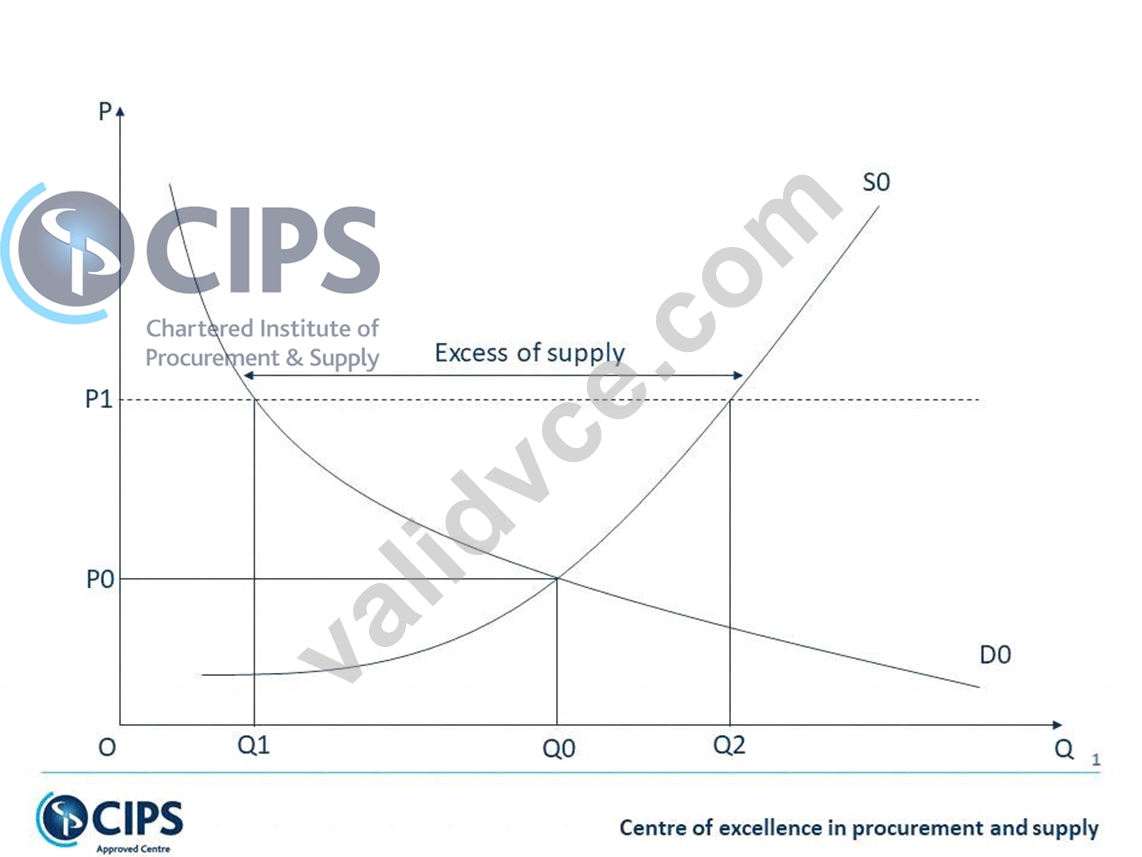
NEW QUESTION 40
A procurement professional is preparing for anegotiation with supplier. She is setting targets for price which her company is seeking to achieve. Which of the following acronyms can help her identify limits before engaging in the negotiation?
- A. PPCA
- B. RAQSCI
- C. MIL
- D. TIMWOOD
Answer: C
NEW QUESTION 41
Procurement team is required to improve leverage with their suppliers through spend consolidation. To check whether there is any opportunity to consolidate spend, which of the following should be priority of procurement team?
- A. Value engineering
- B. Price analysis
- C. Spend analysis
- D. Total cost analysis
Answer: C
Explanation:
Explanation
In order to identify opportunities where you can increase your leverage with supplier, you need to understand your spend. Undertaking spend analysis of your accounts payable (AP) data is an essential first step here.
NEW QUESTION 42
Where can we find the data on macroeconomics?
1. From trade journal
2. From supplier's marketing catalogue
3. From stock exchange market
4. From government's statistics
- A. 2 and 4 only
- B. 1 and 3 only
- C. 1 and 2 only
- D. 3 and 4 only
Answer: D
Explanation:
Explanation
Macroeconomic indicators are statistics or data readings that reflect the economic circumstances of a particular country, region or sector. They are used by analysts and governments to assess the current and future health of the economy and financial markets.
Macroeconomic indicators will vary in their meaning and the impact that they have on the economy, but broadly speaking there are two main types of indicator.
- Leading indicators, which forecast where an economy might be heading. They are often used by governments to implement policies because they represent the first phase of a new economic cycle. These include the yield curve, interest rates and share prices.
- Lagging indicators, which reflect an economy's historical performance and only change after a trend has been established. They are used to confirm a trend is underway. These include gross domestic product (GDP), inflation and employment figures.
There is also the category of coincident indicators, but these are generally grouped in with lagging indicators as they either happen at the same time or after an economic shift.
The best macroeconomic indicator to watch will heavily depend on your personal preferences, what positions you are taking and which country your portfolio is focused on. However, there are some very common indicators that most traders and investors will keep an eye on.
For simplicity's sake, we have split these out into leading and lagging indicators.
Top leading indicators:
1. The stock market
2. House prices
3. Bond yields
4. Production and manufacturing statistics
5. Retail sales
6. Interest rates
Top laggingindicators:
1. GDP growth rates
2. The Consumer Price Index (CPI) and inflation
3. Currency strength and stability
4. Labour market statistics
5. Commodity prices
A procurement professional may find stock market data from the security exchange, whilemost lagging indicators (such as GDP, CPI, unemployment rate, currency and inflation rate, etc) can be found from government statistics data.
NEW QUESTION 43
Rose is a senior buyer from a skiing equipment retailer. Rose is concerned about the current ski boot shortage and the number of invoicing problems from a key supplier. Shehas decided to have a video conference with Victor, CEO of the supplier. Initially, she intends to threaten Victor with contract termination unless he can improve the situation. However, she is a little wary of doing this as the switching costs are high. Eventually, she decides to seek solutions by encouraging the other party to offer their views and ideas. Rose also prepares some ideas to discuss with Victor. Which of the following is the persuasion method that Rose intends to use in the forthcoming conference?
- A. Persuasive reasoning (push)
- B. Collaborative (pull)
- C. Visionary (pull)
- D. Directive (push)
Answer: B
Explanation:
There are two major persuasion methods: 'push' and 'pull'.
Persuasion can be defined as encouraging someone to dosomething that you want them to do for you.
Persuasion is reasoning with someone so that they will believe or do something they might not otherwise do.
Persuasion can be considered as 'pushing' on TOP so that they can accept the change in attitude or behaviour as a result of your actions.
Influence is the ability to affect the manner of thinking of another. Influence can be considered as pulling on TOP so that you achieve the same result, but TOP feels they have changed their attitude or behaviour as a result of their reflection and thinking, and not your direct actions.
There are multiple variables to consider when choosing between 'push' and 'pull'. Professor Fiona Dent of Ashridge Business School proposes situations when each style might be most appropriate, breaking down push into 'directive' and 'reasoning' and 'pull' into 'collaborative' and 'visionary':
Table Description automatically generated
Text Description automatically generated
In the scenario, Rose intends to let both parties exchange their views and ideas so that solutions to current problems can be found. This is the typical characteristic of collaborative (pull) method.
NEW QUESTION 44
End users are the only stakeholders that are involved in the preparation of a negotiation. Is this statement true?
- A. No, because budget holders also play an important role
- B. No, because end-users are external stakeholders
- C. Yes, because end-users have greaterexpert power
- D. Yes, because only end-users understand their demand
Answer: A
Explanation:
Explanation
Commercial negotiation objectives should bedriven by the business needs of the organisation. Organisations are made up of different stakeholder groups, some of whom may have different, even conflicting objectives.
From a negotiation perspective, stakeholders can be defined as persons or groups thathave interest (or stake) in the outcome of the negotiation you are leading or participating in.
CIPS distinguishes between 3 sets of stakeholders:
- Internal stakeholders
- Connected stakeholders
- External stakeholders
End-users are examples of internalstakeholders. They are the people who will benefit from the purchase of a product or service. However, their interest may conflict with other groups, i.e. the budget controllers whose objective is minimising the expense. In negotiation perspective, procurement should involve different groups of stakeholder.
LO 1, AC 1.1
NEW QUESTION 45
Sumitomo Rubber Industries (SRI) is a Japan-based tyre manufacturer. In order to increase production, SRI is sourcing rubber from Southeast Asian firms. Which of the following micro factors are most likely to shift the balance of power to supplier? Select TWO that apply
- A. SRI sets up its own rubber plantation
- B. Rubber from different suppliers is virtually similar
- C. Costs of changing suppliers are high
- D. SRI's purchase amount makes significant proportion of supplier revenue
- E. There are no close substitutes for rubber
Answer: C,E
Explanation:
There are many factors that can influence the balance of power in a negotiation. These factors are classified into 3 levels:
Macro level: STEEPLE framework: social, technological, economic, environment, political, legal and ethical Micro level: Porter's five forces: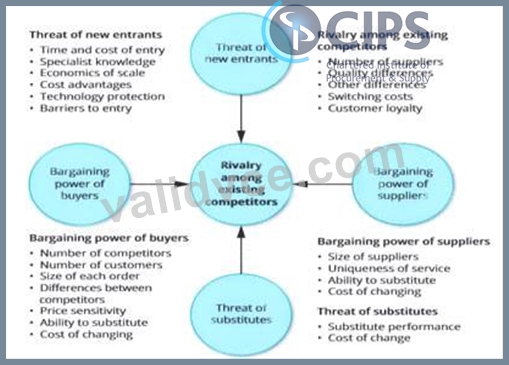
Diagram Description automatically generated
One-to-one buyer-supplier dynamics.
The question asks about the micro factors that increases supplier's bargaining power. Among 5 answers, only 2 are likely to increase buyer's power:
There are no close substitutes for rubber: the buyer has to buy rubber, not any other material.
Costs of changing suppliers are high: buyer entails a large barrier if they want to switch supplier.
Other answers cannot be correct because:
SRI sets up its own rubber plantation: Buyer secures its own supply
SRI's purchase amount makes significant proportion of supplier revenue: Suppliers are reliant on buyer. If the buyer stops buying from them, they can face serious cash flow problems Rubber from different suppliers is virtually similar: undifferentiated product would shift the power balance towards buyer.
NEW QUESTION 46
......
CIPS L4M5 Exam Syllabus Topics:
| Topic | Details |
|---|---|
| Topic 1 |
|
| Topic 2 |
|
| Topic 3 |
|
| Topic 4 |
|
| Topic 5 |
|
| Topic 6 |
|
| Topic 7 |
|
L4M5 Exam Dumps Pass with Updated 2022 Certified Exam Questions: https://torrentpdf.validvce.com/L4M5-exam-collection.html
